What Is a Master CV and Why You Need One
A master CV is the source document behind every strong application. Learn what to include, how to structure it, and how it makes tailoring faster and better for AI.

Most people tailor their CV the hard way.
They open last week's version, start deleting bullets that do not fit the new role, rewrite a few lines, move sections around, save it as "final-v7-actually-final," and send it off.
Then the next job asks for the exact experience they just deleted.
So they dig through old files, try to remember what they wrote six months ago, and rebuild the same accomplishments from memory. That is how good experience gets lost, dates become inconsistent, and every application takes longer than it should.
The fix is simple: create a Master CV.
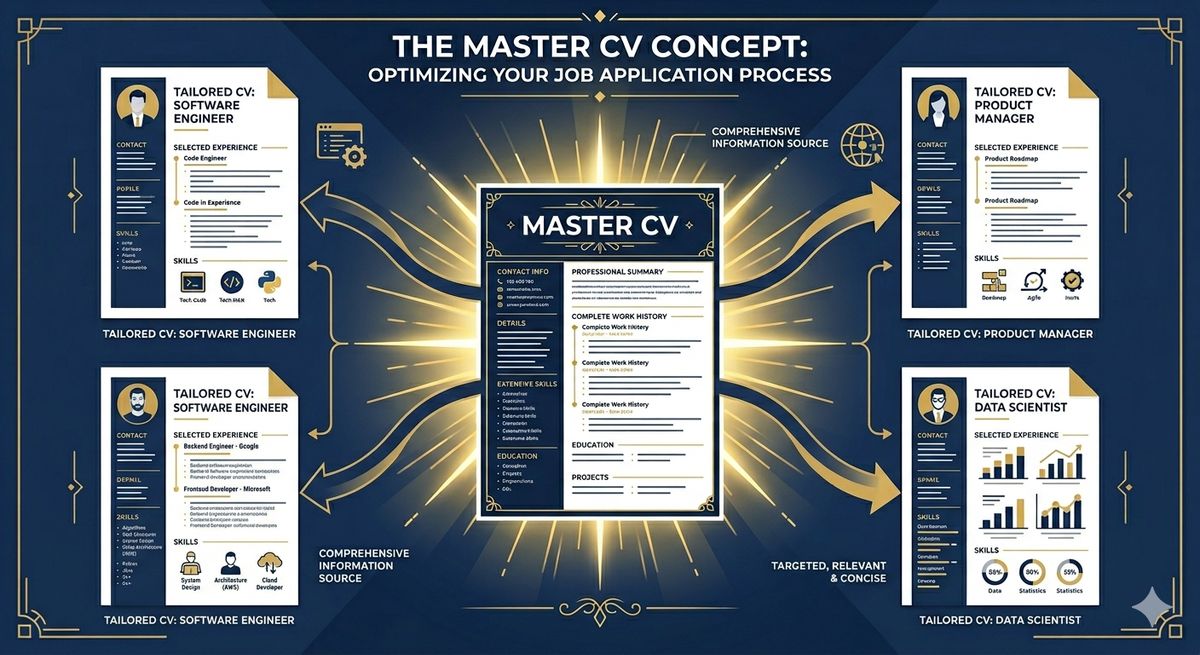
A master CV, sometimes called a master resume, is not the document you send to employers. It is the source document behind every tailored CV you send. Think of it as your complete career inventory: every role, every project, every certification, every quantified win, all in one place.
Once you have that, tailoring stops being a rewrite job. It becomes a selection job.
What Is a Master CV?
A master CV is your complete, unfiltered record of professional experience.
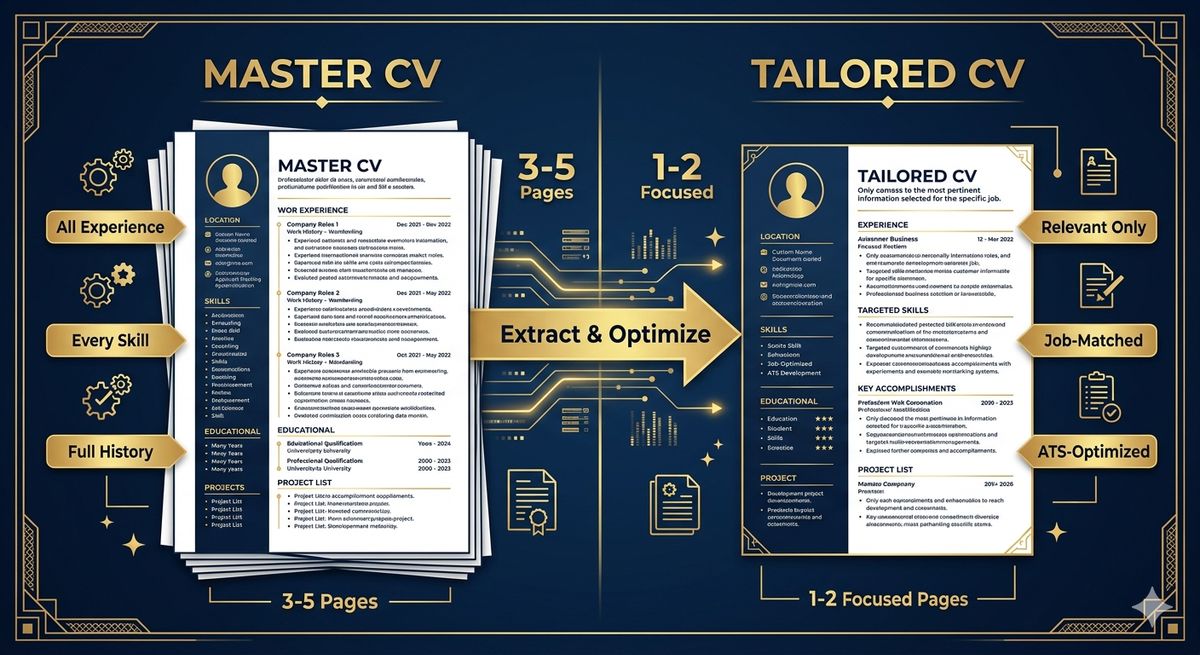
It usually runs 3 to 5 pages, sometimes longer if you have a long career, publications, or a large project portfolio. That is normal. The point of a master CV is not brevity. The point is completeness.
Your tailored CV is the opposite. That is the version you actually send to employers. It is usually 1 to 2 pages, focused only on the experience that matters for a specific role.
Here is the distinction that matters:
- Master CV: everything, for your eyes only
- Tailored CV: relevant experience only, sent to employers
That difference sounds small, but it changes how you manage your job search.
Without a master CV, every new application starts from a partial document. You are always editing a reduced version of your experience. That means you are constantly at risk of forgetting a certification, dropping a metric, or underselling a project that would have mattered for this specific role.
With a master CV, you always start from the full picture.
Why You Need a Master CV
The biggest reason is simple: you need one source of truth.
When your experience lives across five different resume versions, one old LinkedIn profile, and three half-finished cover letters, mistakes are inevitable. Titles drift. Dates stop matching. Numbers get rounded differently. You start describing the same project in two completely different ways depending on which file you copied from.
A master CV fixes that.
1. It makes tailoring dramatically faster
Instead of rewriting from scratch, you copy the relevant bullets, reorder them, and tighten the language for the role. That is much faster than trying to remember what you did in a job from four years ago.
2. It keeps your facts consistent
If you always pull titles, dates, certifications, tools, and achievements from one source document, your applications stay aligned. That matters for credibility. Recruiters notice inconsistencies, and so do background checks.
3. It helps you quantify your work
Most people under-document their own achievements. They remember the role but forget the outcome. The master CV gives you a place to capture metrics while they are still fresh:
- Revenue impact
- Cost savings
- Time saved
- Team size
- Customer growth
- Conversion improvements
- Process improvements
Once those numbers are stored in one place, you do not have to reinvent them every time.
4. It makes AI output much better
This is the part many job seekers miss.
AI is only as good as the context you give it. If you upload a stripped-down 1-page resume, the AI can only work with the fragments on that page. It cannot surface a forgotten project, a relevant certification, or a stronger achievement that you left out for a previous role.
If you upload a full master CV instead, the AI has real context. It can select the most relevant material, preserve consistency across documents, and generate a stronger tailored CV without inventing anything.
Better input produces better output. A master CV is the best possible input.
What to Include in a Master CV
If it is real and professionally relevant, it belongs in your master CV.
That includes more than most people think.
All work experience
Not just the last 10 years. Not just the prestigious jobs. Include every role that might provide transferable experience, domain knowledge, leadership evidence, or technical depth.
That does not mean every tailored CV should show every role. It means your source document should.
All education and certifications
Degrees, bootcamps, licenses, short courses, professional certificates, compliance training, language certificates, everything. The certification that felt minor two years ago may be a keyword match today.
All skills
Include both hard and soft skills, but categorize them clearly:
- Technical skills
- Tools and platforms
- Languages
- Methodologies
- Leadership and communication strengths
Projects, publications, and volunteer work
Many people keep these in separate documents. That is a mistake. Side projects, freelance work, conference talks, publications, and volunteer roles often become differentiators, especially when you are changing industries or applying internationally.
Achievements with metrics
This is the most important section to build carefully. Do not just write responsibilities. Capture outcomes.
Weak:
- Managed onboarding process
Better:
- Redesigned onboarding workflow, reducing time-to-productivity from 21 days to 12 days
Your master CV should preserve the strongest version of each accomplishment so you can pull it into tailored applications later.
Languages and additional information
Language proficiency matters more than people realize, especially in Europe and international roles. Include:
- Languages with level or proficiency
- Work authorization
- Relevant relocation status
- Publications
- Professional memberships
- Awards
- References, if you want to maintain them in one place
How to Structure a Master CV
The best master CV structure is not fancy. It is organized, comprehensive, and easy to skim.
Use this framework:
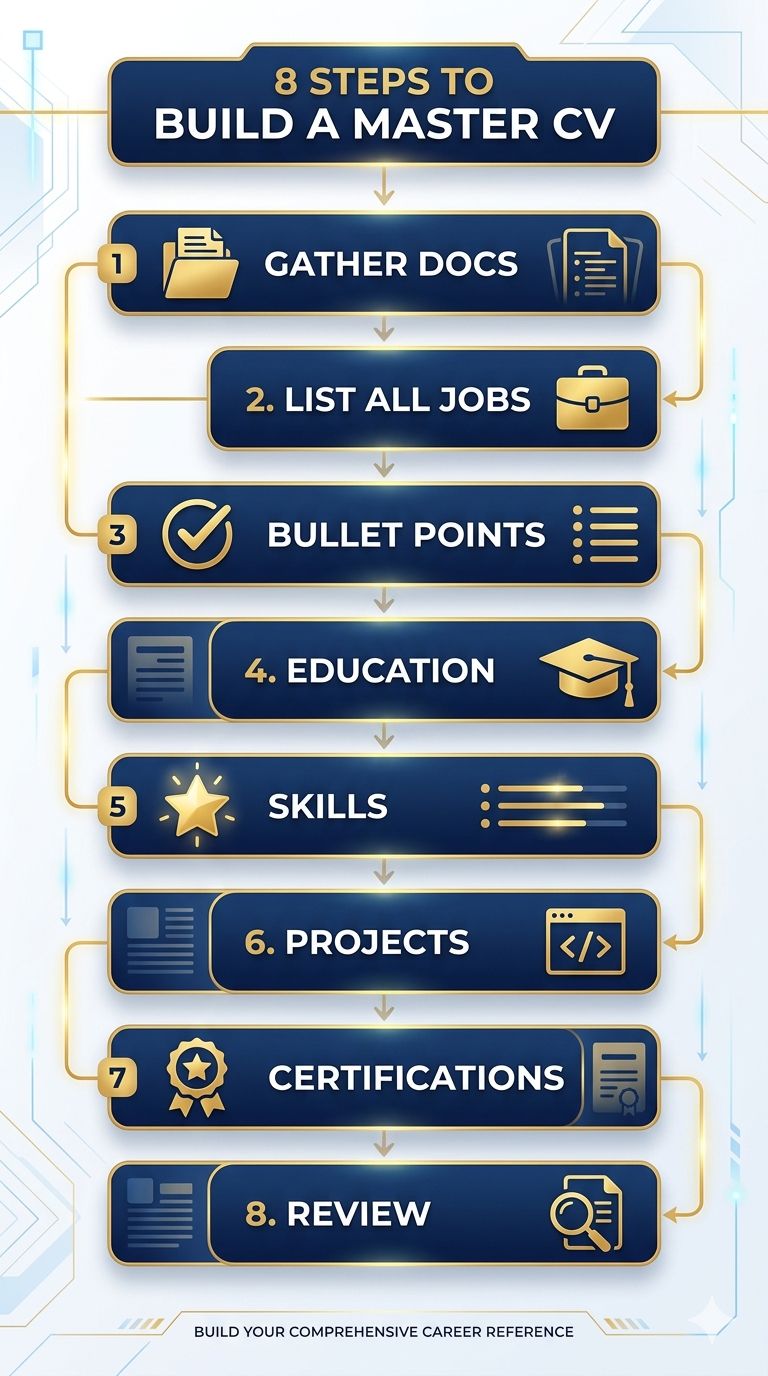
1. Personal Information
Include your name, email, phone, LinkedIn, portfolio, and location. If you are applying across markets, you can also keep alternative location or work authorization notes here for easy reuse.
2. Professional Summary
Instead of forcing one generic summary, keep multiple summary versions for different directions:
- Product manager version
- Operations manager version
- Data analyst version
- Customer success version
That way, you are not rewriting the top section every time.
3. Work Experience
This should be the biggest section.
For each role, keep:
- Company
- Title
- Location
- Start and end dates
- Full scope of responsibilities
- All strong achievement bullets
- Tools, systems, or methods used
Do not over-edit here. The master CV is the place to be comprehensive.
4. Education and Certifications
Keep degrees, institutions, graduation dates, notable coursework if relevant, and every certification that may matter for future roles.
5. Skills
Group skills by category rather than dumping them into one long list. That makes it easier to extract the right subset later.
6. Projects and Publications
This section is especially valuable if your formal job titles do not fully represent your actual capabilities.
7. Additional Information
Languages, awards, volunteer work, work authorization, speaking engagements, and references can live here.
Master CV vs Tailored CV
This is where people get confused, so let us make it blunt.
Your master CV is not your application CV.
Here is the difference:
- Master CV: 3 to 5 pages, complete history, internal use only
- Tailored CV: 1 to 2 pages, role-specific, sent to employers
The relationship between them is straightforward:
Master CV = source
Tailored CV = output
If you send the master CV to employers, it is usually too long, too broad, and too unfocused. If you try to tailor without a master CV, you waste time and lose valuable information.
The right workflow is:
- Maintain the master CV
- Pull relevant content for each role
- Reorder and tighten based on the job description
- Send the tailored version
That is the system.
How to Use a Master CV in Practice
There are two good ways to use it.
Manual workflow
Open the job description and identify the core themes: skills, domain experience, tools, seniority, and measurable outcomes.
Then open your master CV and pull the bullets that match those themes best. Move the strongest evidence to the top. Trim anything irrelevant. Tighten the language so it mirrors the job description without becoming robotic.
This is still manual, but it is far faster than rewriting from scratch.
AI-assisted workflow
This is where the master CV becomes a force multiplier.
Upload your master CV once, then let AI generate tailored applications from that complete context. Because the system sees your full background, it can choose the most relevant experience and keep your claims consistent across your CV, cover letter, and email.
That is a much stronger workflow than asking AI to guess from a thin one-page resume.
Maintenance rule
Update your master CV every time something changes:
- New job
- New certification
- New project
- Major achievement
- Promotion
- New tool or language proficiency
If you wait until you are already job hunting, you will forget details.
Common Mistakes to Avoid
The master CV is powerful, but only if you use it correctly.
Mistake 1: Sending the master CV directly
Do not do this unless an academic or executive context specifically asks for a full CV. For normal job applications, it is too long and too broad.
Mistake 2: Letting it go stale
A master CV only works if it is current. Update it while the details are still fresh.
Mistake 3: Storing vague bullets
"Responsible for project delivery" is useless. If your source material is vague, your tailored output will also be vague.
Mistake 4: Missing metrics
If you improved something, quantify it. If you led something, specify the team size. If you saved time or money, capture the number.
Mistake 5: Inconsistent dates and titles
Use one format and stick to it. Consistency matters.
Mistake 6: Treating it like a polished final document
It does not need to look beautiful. It needs to be complete, accurate, and easy to mine.
Start With a Master CV Template
If you do not have a master CV yet, start with a simple structure and build from there.
You can use Karko's Master CV template as your base. It gives you the right sections, a practical structure, and a clear way to capture all the raw material you will need for future applications.
The key is not perfection. The key is completeness.
Once the source document exists, every future application gets easier.
Try It With Karko AI
Karko AI is built around this exact workflow.
You upload your master CV once. Then, for each job description, Karko generates a tailored CV, cover letter, and application email using your real experience as source material. That means:
- Faster tailoring
- More consistent facts
- Better ATS keyword alignment
- No need to rewrite your history every time
This is the practical advantage of a master CV. It turns your job search from repeated reinvention into a repeatable system.
If you are serious about applying efficiently without sacrificing quality, build the master CV first. Then use it the right way.
Generate From Your Master CV Free — 2 Applications, No Credit Card
Wasim Jalali is the founder of Karko AI. He built it because he was broke, job hunting, and tired of rebuilding the same application materials over and over. Now he's making sure nobody else has to.
Turn Your Master CV Into Tailored Applications
Upload your full career history once, then generate tailored CVs, cover letters, and emails in 90 seconds.
Generate From Your Master CV FreeRelated articles.
How to Tailor Your Resume to a Job Description
Tailored resumes get 1.6x more interviews than generic ones. Learn the exact process for matching your CV to any job description in minutes, not hours.
German CV vs American Resume: What's Actually Different?
Applying with the same document in Germany and the US is a mistake. Here are the real differences in format, personal details, tone, and ATS expectations in each market.
ATS Resume Format Guide 2026: What Works and What Breaks
76% of resumes are rejected by ATS before a human sees them. Learn the exact formatting rules for Workday, Greenhouse, Lever, and other major ATS platforms.