German CV vs American Resume: What's Actually Different?
Applying with the same document in Germany and the US is a mistake. Here are the real differences in format, personal details, tone, and ATS expectations in each market.

If you apply for jobs in Germany with a standard American resume, you will often look underprepared before anyone even reads your experience.
And if you apply in the US with a traditional German Lebenslauf, you can trigger the opposite problem: too much personal information, too much formality, and in some cases an immediate rejection.
This is one of the most common mistakes international job seekers make. They assume a CV is a CV is a CV. It is not.
Germany and the United States use different hiring conventions, different expectations around personal information, and slightly different ideas of what a "professional" application looks like. Some of those differences are cultural. Some are legal. Some are just habits employers are used to seeing.
If you want interviews, you need to adapt.
The Key Differences at a Glance
Let us start with the practical version.
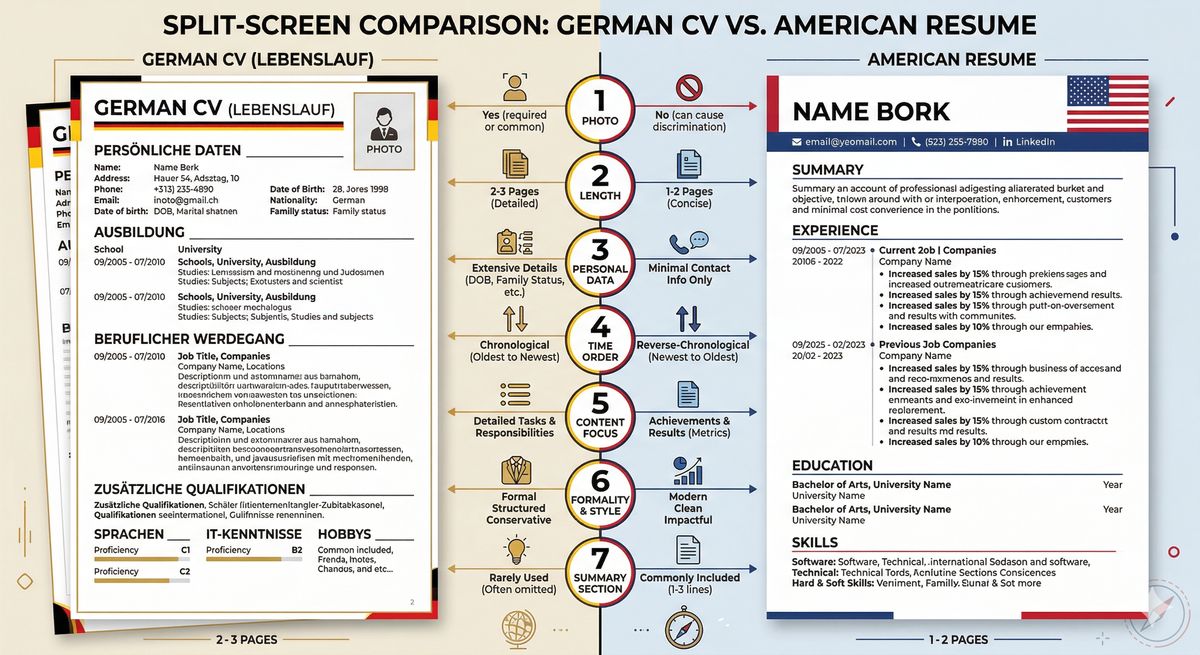
Length
In the US, a resume is usually 1 page for early-career candidates and 2 pages for more experienced professionals.
In Germany, a 2-page Lebenslauf is completely normal, and in some cases 3 pages is acceptable for senior or highly detailed profiles.
Photo
In the US, do not include a photo. It creates legal risk around discrimination and is outside normal hiring practice.
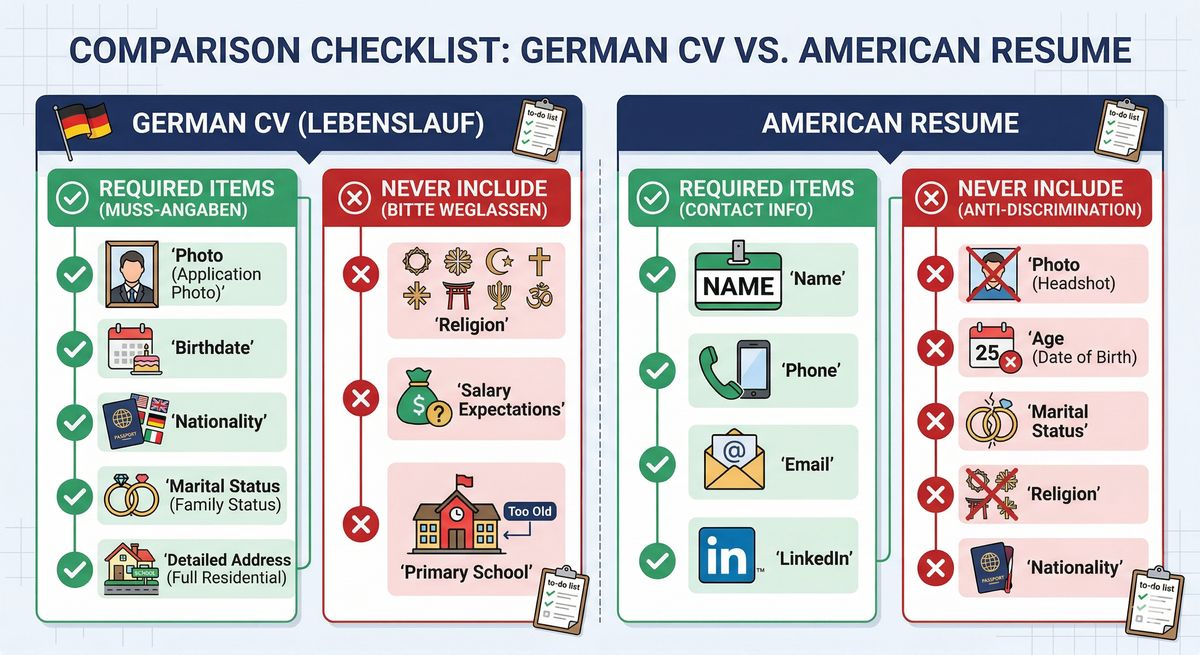
In Germany, a professional photo is still often expected, especially in traditional industries or direct applications. It is not universally mandatory anymore, but omitting it can still make your document look incomplete to some employers.
Personal information
American resumes usually include only:
- Name
- Phone
- LinkedIn or portfolio
- General location
German CVs often include more:
- Full address
- Date of birth
- Place of birth
- Nationality in some cases
- Sometimes marital status, though this is less common than it used to be
Tone
US resumes are direct, concise, and heavily outcome-focused.
German CVs tend to be more formal and more comfortable with detail.
Signature
American resumes do not use signatures.
German CVs often end with place, date, and signature, especially in more traditional application contexts.
What a German CV Actually Looks Like
The German word you will see most often is Lebenslauf. In practice, that means a structured, reverse-chronological career document tailored to German expectations.
Traditional German employers often expect the document to look complete in a way American employers do not.
Common German CV requirements
1. Professional photo
Usually placed in the top-right area. Not a passport photo, not a cropped vacation picture, not a selfie. A proper headshot.
This is the biggest culture shock for Americans applying in Germany. In the US, a photo looks risky. In Germany, depending on the employer, no photo can make the application feel unfinished.
2. Birth date and place
Still commonly included in Germany, even though international applicants are often surprised by it.
3. Nationality
Sometimes included, especially when employers are thinking about language, location, or work authorization context. Not every applicant includes it, but it still appears frequently.
4. Full address
German applications tend to use fuller contact information than US resumes.
5. Signature and date
At the bottom, many German CVs include the city, current date, and a signature. That signals formality and completeness.
6. Reverse-chronological structure
Just like in the US, your most recent experience comes first. That part is not different. What changes is the amount of detail and the expectation that the document feels complete.
What an American Resume Requires
American resumes are narrower and more defensive because of hiring norms and anti-discrimination laws.
No photo
This is non-negotiable in most US hiring contexts. A photo can create discomfort for recruiters and is outside best practice.
No birth date
Age discrimination laws are part of the reason. Your date of birth is not relevant to whether you can do the job.
No nationality, marital status, or personal profile details
These fields are common in some countries and inappropriate in the US.
Contact information only
Keep it to what helps a recruiter reach you:
- Name
- Phone
- Portfolio, GitHub, or website if relevant
- City and state if useful
No signature
An American resume ends when the content ends. No sign-off, no date line, no city signature block.
Formatting Differences That Actually Matter
This is where global advice gets messy, because not all jobs are processed the same way.
Germany allows more traditional formatting
In Germany, two-column CVs, photo blocks, and more visually structured layouts are more common than in the US. That is true.
But there is an important caveat: ATS software still prefers simple structure.
If you are applying through an online portal, using Workday, Greenhouse, Lever, SAP SuccessFactors, or any similar system, the safest move is still a clean layout with predictable section hierarchy and readable text order.
That means the real advice is not "Germany loves fancy formatting." The real advice is:
- Traditional direct applications in Germany may tolerate richer layouts
- Online applications in Germany still benefit from ATS-safe structure
- US applications should almost always stay single-column and ATS-first
The US is stricter on ATS formatting
American resume advice is more uniform because the ATS expectation is more dominant:
- Single-column
- No tables
- No text boxes
- Standard section headings
- Clean fonts
- Consistent date formatting
Fonts and design
Both markets still want professional, readable typography. Neither market rewards gimmicks.
The difference is that German applications may tolerate slightly more visual structure, while US applications punish it faster when ATS is involved.
Language and Tone: Formal vs Results-Driven
This difference is easy to underestimate.
German CV tone
German applications often lean more formal, more complete, and more reserved. The writing style tends to describe experience in a way that feels stable, structured, and serious.
American resume tone
American resumes are much more aggressively action-oriented. Recruiters expect fast scanning and clear evidence of impact.
Examples:
- German style: "Responsible for coordination of cross-functional reporting processes"
- US style: "Led cross-functional reporting process, reducing weekly reporting time by 35%"
The US version is punchier, more measurable, and more outcome-heavy.
That does not mean German applications ignore results. It means the expected tone and presentation are different.
The same experience can be framed differently without changing the truth.
A US resume might say:
- "Reduced monthly reporting time by 40% through dashboard automation"
A German CV might present the same accomplishment in a more formal, descriptive way that feels closer to local expectations. The work is identical. The positioning changes. That is why international applications are not just translation problems. They are adaptation problems.
Common Mistakes Americans Make When Applying in Germany
This is where a lot of good candidates lose interviews for avoidable reasons.
No photo, no context, no completeness
An American-style resume can look too sparse in Germany, especially if it is only one page and stripped of the details local employers expect.
Too casual in tone
US resume language can sound overly promotional or informal when translated directly into a German-market application.
Missing personal details
If the employer expects a traditional Lebenslauf, leaving out common fields can make your application feel non-local.
Assuming one page is always better
In Germany, one page can make an experienced candidate look junior or under-documented.
Common Mistakes Germans Make When Applying in the US
The reverse happens just as often.
Including a photo
This is the biggest red flag. In the US, it can make recruiters uncomfortable immediately.
Including birth date or nationality
American recruiters do not want that information and may actively avoid engaging with documents that include it.
Writing a 3-page CV for a standard role
For most US roles, that is too long unless you are at a very senior level or in an academic context.
Using overly formal, passive language
If your resume sounds stiff and abstract, it will underperform in six-second scans.
Listing responsibilities without metrics
US resumes live or die on clear outcomes. What changed because of your work?
ATS Considerations in Both Markets
This is the point that matters most in 2026: both markets increasingly run through software before a human sees your document.
So while the cultural conventions differ, the parser rules are not that different.
Both German and American applications perform better when they use:
- Clear section headings
- Consistent dates
- Readable text order
- Standard bullet structure
- No unnecessary design elements that block parsing
That is why the smartest workflow is not choosing between "German tradition" and "American ATS." It is choosing the right version for the right context.
For direct German applications, you may use a market-appropriate format with a photo and local conventions.
For portal-based German applications, you often want something closer to an ATS-safe structure.
For the US, ATS-safe structure is the default almost all the time.
How Karko AI Handles Both Markets
This is exactly the problem Karko AI is built to solve.
Karko does not assume every applicant is targeting the same country with the same resume rules. It supports both US and German application workflows using the same underlying career history.
US templates
Karko includes four US-focused templates:
- Premium ATS
- Modern Professional
- Executive
- Classic Green
These are optimized for US expectations: clear hierarchy, ATS-safe structure, and concise, results-driven presentation.
German templates
Karko also includes two German-specific templates:
- German ATS
- German Classic
These are built for German Lebenslauf conventions, including support for region-appropriate layout and tone.
The real advantage is that you do not need to maintain two completely different career documents by hand. You keep one complete source of truth, then generate the right market-specific output based on where you are applying.
The Practical Rule
If you remember nothing else, remember this:
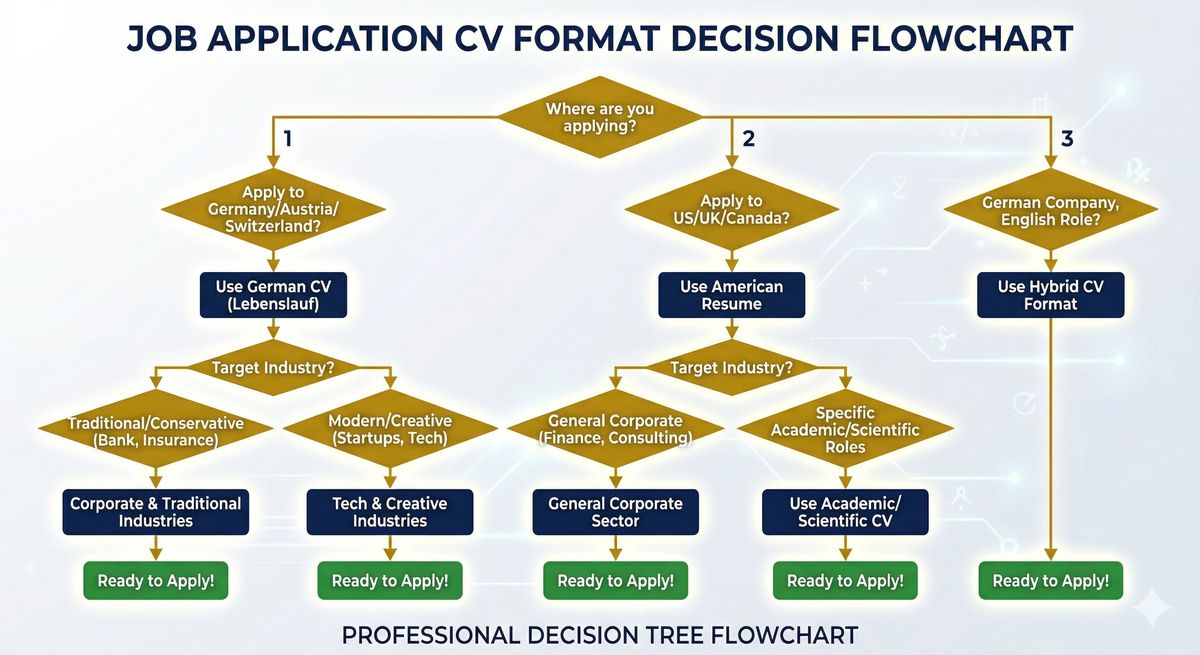
Do not use the same CV for Germany and the US.
The content overlap may be high, but the packaging is different. Personal details, photo expectations, length, tone, and legal norms all change.
A strong international job search is not about picking one perfect format. It is about adapting the same real experience to the market you are targeting.
Try It Yourself
Karko AI lets you generate a German or US-ready CV from the same master profile, with the right formatting, tone, and structure for the target market.
That means less manual reformatting, fewer cultural mistakes, and a better chance of looking like you understand the market you are applying into.
Generate Market-Specific CV Free — 2 Applications, No Credit Card
Wasim Jalali is the founder of Karko AI. He built it after seeing how many strong candidates were rejected for avoidable formatting and market-mismatch mistakes, not lack of ability.
Create a German or US CV in 90 Seconds
Use the same career history to generate region-appropriate CVs with the right format, tone, and conventions.
Generate Market-Specific CV FreeRelated articles.
How to Tailor Your Resume to a Job Description
Tailored resumes get 1.6x more interviews than generic ones. Learn the exact process for matching your CV to any job description in minutes, not hours.
What Is a Master CV and Why You Need One
A master CV is the source document behind every strong application. Learn what to include, how to structure it, and how it makes tailoring faster and better for AI.
ATS Resume Format Guide 2026: What Works and What Breaks
76% of resumes are rejected by ATS before a human sees them. Learn the exact formatting rules for Workday, Greenhouse, Lever, and other major ATS platforms.