How to Tailor Your Resume to a Job Description
Tailored resumes get 1.6x more interviews than generic ones. Learn the exact process for matching your CV to any job description in minutes, not hours.

Generic resumes don't work anymore.
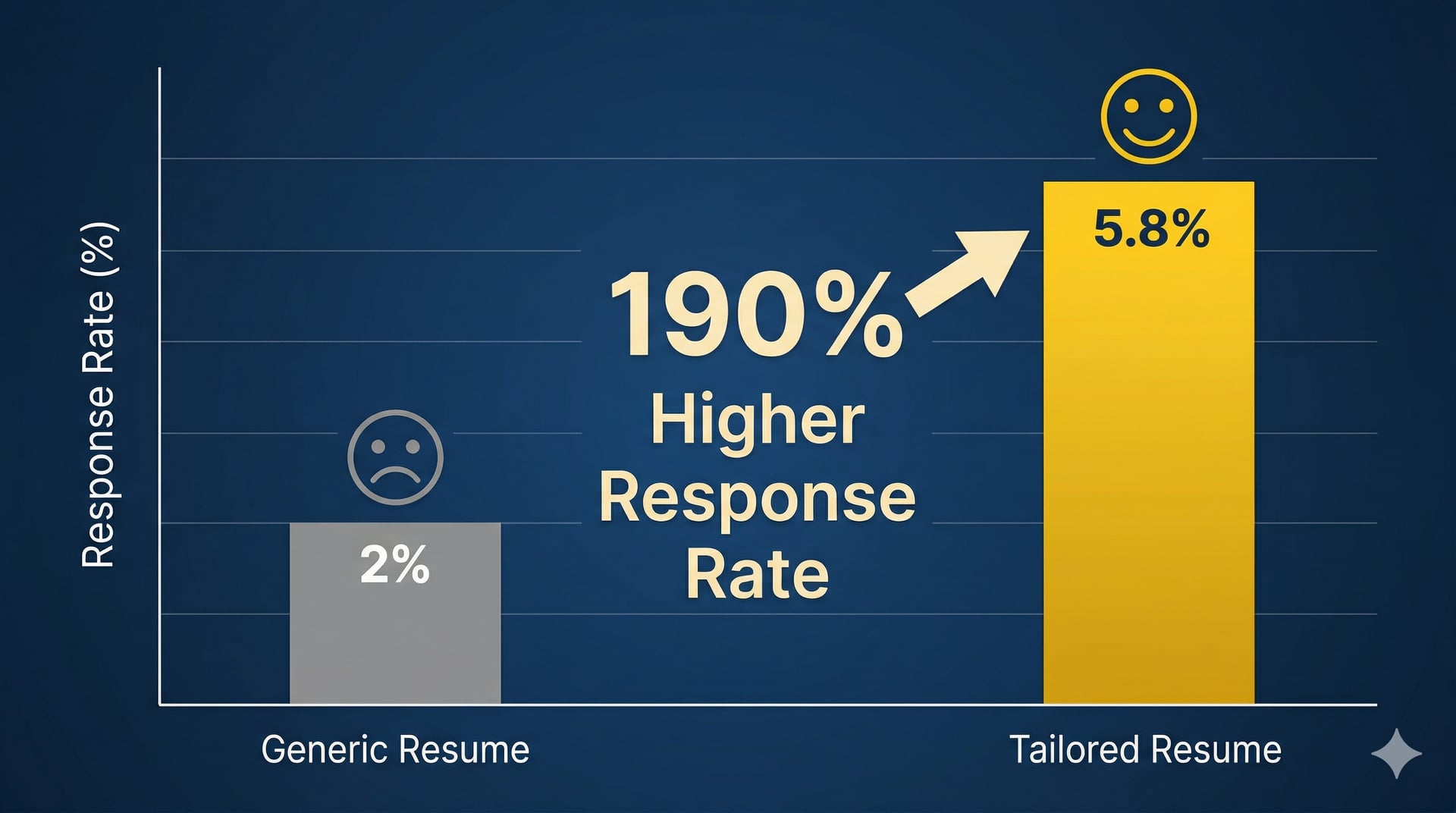
You already know this if you've sent 50 applications and heard nothing back. The data confirms it: tailored resumes convert to interviews at a 5.8% rate, which is 1.6 times higher than untailored ones. (Source: Huntr's 2025 Job Search Trends Report, analyzing 1.7 million applications.)
But here's the problem: tailoring a resume manually takes 15 to 25 minutes per job. If you're applying to 100 jobs, that's 42 hours of reformatting, rewriting, and keyword hunting.
This guide breaks down exactly how to tailor a resume to a job description, why it works, and how to do it fast enough that you can actually apply to enough jobs to get results.
What "Tailoring a Resume" Actually Means
Tailoring doesn't mean lying. It means emphasizing the parts of your real experience that align most closely with what the employer is looking for.
You have a finite amount of space on a one or two-page CV. Every bullet point is real estate. A generic resume wastes that space on accomplishments that don't matter for the specific role. A tailored resume uses that space strategically.
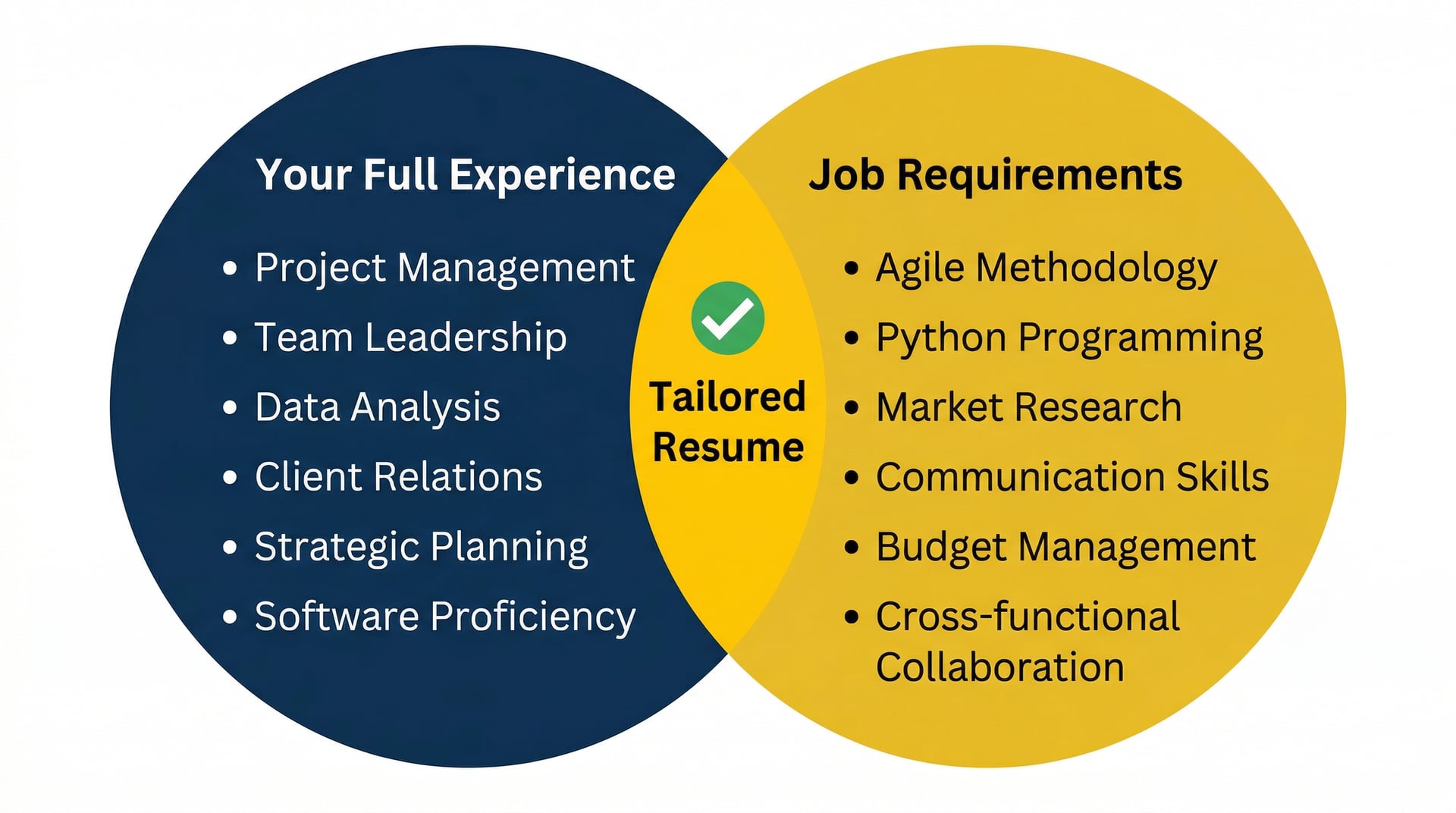
Here's what tailoring involves:
1. Keyword alignment: The job description lists required skills. Your resume should use the same keywords where you genuinely have that experience. If the JD says "Python" and your resume says "scripting languages," you're losing points with both the ATS and the hiring manager.
2. Prioritization: Move the most relevant experience to the top of each section. If you have 10 years of experience but only 3 are relevant to this role, lead with those 3.
3. Bullet point tuning: Rewrite achievement bullets to emphasize the outcomes that matter for this role. If the job is about scaling systems, your "improved database query speed by 40%" bullet moves up. If the job is about team leadership, your "mentored 5 junior engineers" bullet moves up.
4. Section emphasis: Some roles care about certifications. Some don't. Some care about side projects. Some want to see publications. Tailoring means surfacing what matters and de-emphasizing what doesn't.
Why Tailoring Works (The ATS + Human Reader Combo)
Your resume faces two gatekeepers:
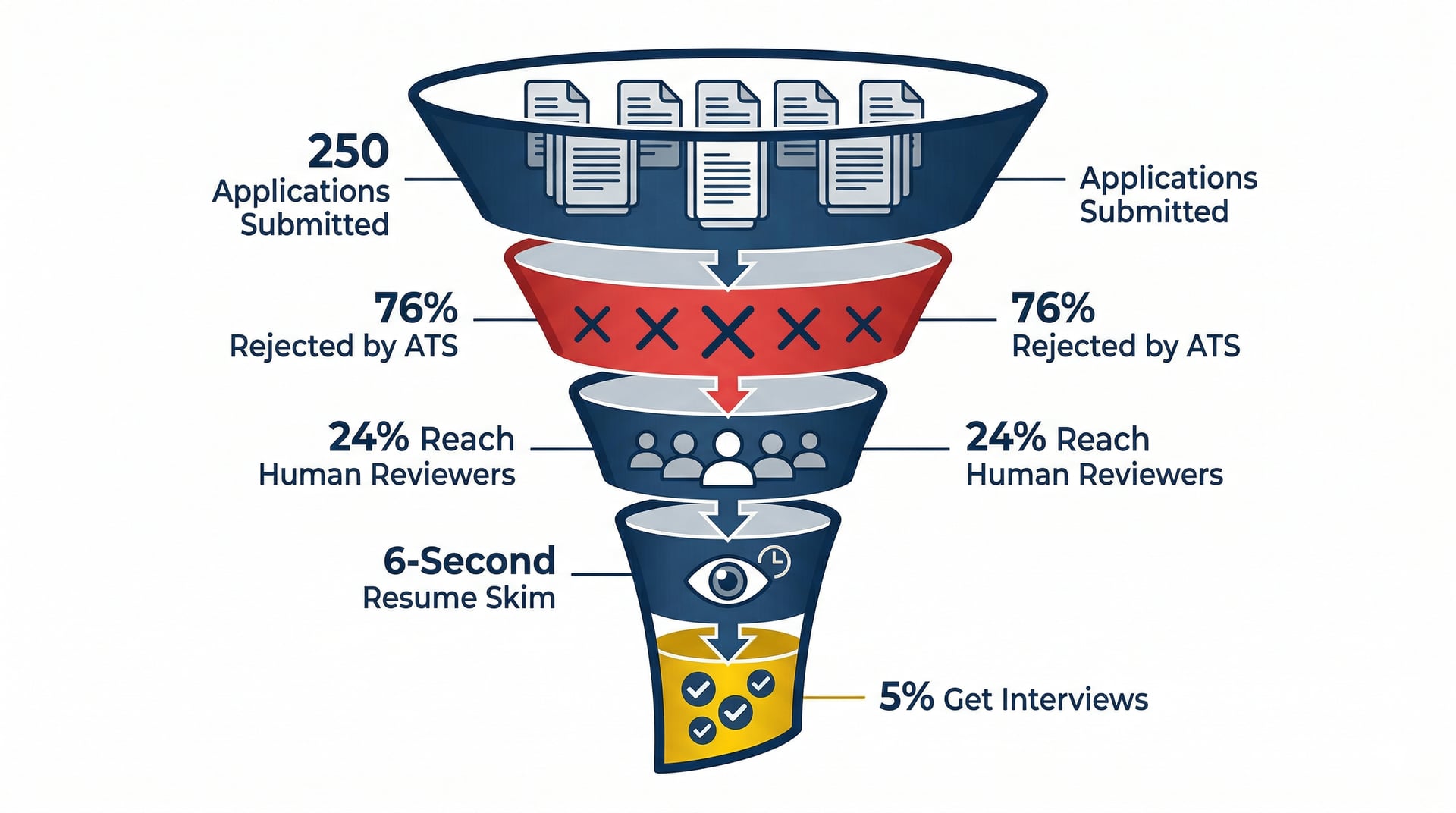
Gatekeeper 1: The ATS (Applicant Tracking System). This software parses your CV and scores it based on keyword matches with the job description. If your CV scores below a threshold (usually 60 to 70% match), a human never sees it. 76% of resumes are rejected by ATS before reaching a recruiter. (Source: Jobscan research.)
Gatekeeper 2: The hiring manager. If you pass the ATS, a human skims your CV for 6 to 8 seconds on average. They're not reading every word. They're scanning for evidence that you can do the job. If your top 3 bullet points aren't relevant, you're out.
Tailoring solves both problems. It gives the ATS the keywords it's scanning for, and it gives the hiring manager the relevant achievements they need to see in those critical 6 seconds.
The 5-Step Process for Tailoring a Resume
Here's the manual process. It works. It's just slow.
Step 1: Extract the Top 10 Keywords from the Job Description
Read the job description and identify:
- Required skills (usually in a "Qualifications" or "Requirements" section).
- Repeated terms (if "stakeholder management" appears 4 times, it's important).
- Action verbs (led, built, scaled, optimized, etc.).
Write these down. These are your target keywords.
Step 2: Map Your Experience to Those Keywords
Go through your CV and find where you have genuine experience matching those keywords. If the JD says "project management" and you've managed projects, that's a match. If the JD says "AWS" and you've used AWS, that's a match.
If you don't have a keyword, do not add it. Fabricating experience backfires in the interview.
Step 3: Rewrite Your Bullets to Emphasize Relevant Achievements
Take your existing bullet points and reframe them to highlight the outcomes that matter for this role.
Generic bullet:
- "Developed new features for the web application."
Tailored bullet (for a backend engineering role):
- "Built RESTful APIs in Python/Flask, reducing average response time by 35% and supporting 10K+ daily users."
Same experience. Different emphasis. The tailored version uses the job description's keywords (Python, APIs, performance) and quantifies the impact.
Step 4: Reorder Your Sections and Bullets
Move the most relevant experience to the top. If the job emphasizes leadership and you have leadership experience in your second-most-recent role, consider restructuring so that experience is more prominent.
Reorder bullet points within each role so the most relevant achievements appear first.
Step 5: Adjust Your Skills Section
If the job description lists 8 required skills and you have 6 of them, make sure those 6 are prominently listed in your Skills section. Remove or de-emphasize skills that aren't relevant to this role.
Time investment: 15 to 25 minutes per job, assuming you're efficient.
The Problem: Volume vs. Quality
Here's the math:
To land one job offer in 2026, you need 32 to 200+ applications depending on the role, industry, and market. Let's use 100 as a reasonable target.
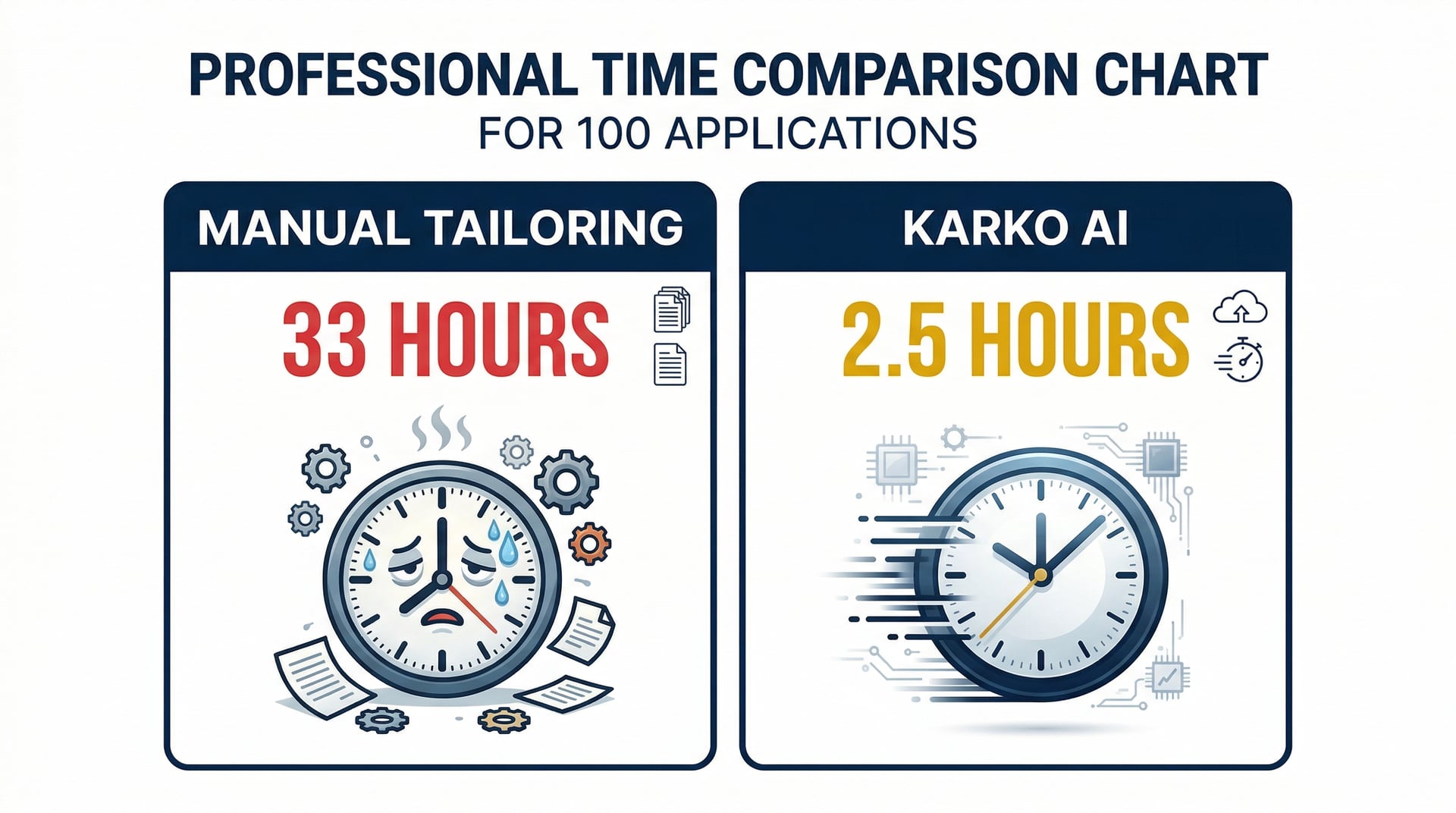
If tailoring takes 20 minutes per job, that's 33 hours of work just on resume tailoring. Add another 15 hours for cover letters and application emails, and you're at 48 hours of unpaid labor.
Most job seekers can't sustain that. So they fall into one of two traps:
Trap 1: Send a generic resume to 200 jobs. Fast, but callback rate drops to 2% or lower.
Trap 2: Hand-tailor 10 applications and burn out. High quality, but not enough volume to get results.
Neither works.
How AI Changes the Math
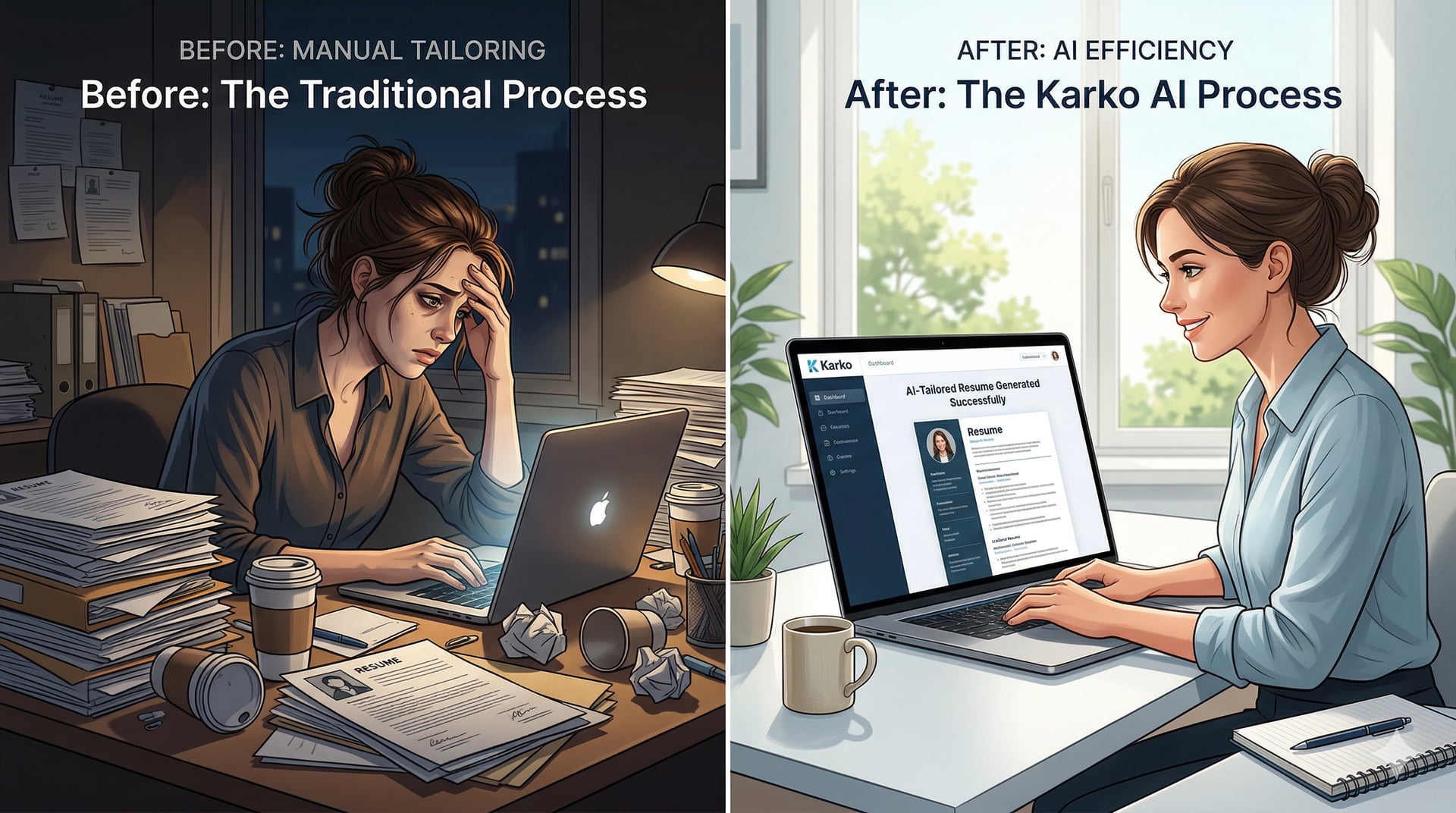
Karko AI tailors your resume in under 90 seconds. Same quality as a hand-tailored CV, roughly 40x faster.
Here's how it works:
- You upload your Master CV once (your complete, structured work history).
- You paste a job description.
- Karko's AI agent extracts the top keywords, maps them to your verified experience, rewrites your bullets to emphasize relevant achievements, and generates an ATS-optimized, tailored CV.
No fabrication. Every claim traces back to your uploaded CV. If you don't have AWS experience, Karko won't add it.
No manual reformatting. The output is a clean, single-column, ATS-safe PDF in one of 6 professional templates.
No keyword guessing. The AI extracts the exact phrasing from the job description and uses it where your CV has equivalent experience.
Time saved: 100 applications at 20 minutes each = 33 hours. With Karko, that drops to 2.5 hours.
Real Example: Before and After Tailoring
Generic CV bullet:
- "Managed customer support team."
Tailored for a "Customer Success Manager" role:
- "Led a 12-person customer success team, reducing churn by 18% through proactive outreach and onboarding improvements."
Why it works: The tailored version uses the job description's language ("customer success," "churn," "onboarding") and quantifies the impact. Same experience, strategically reframed.
Karko AI does this automatically by analyzing the job description, identifying what matters most, and rewriting your bullets to match, all while pulling only from your verified work history.
The 1.6x Advantage
Tailored resumes get 1.6 times more interviews than generic ones. That's not a marginal edge. That's the difference between 3 interviews out of 100 applications and 5 interviews. Over a 3-month job search, that's the difference between 1 offer and 2 or 3 offers.
The job seekers who get hired fastest aren't necessarily the most qualified. They're the ones who get their tailored resume in front of more hiring managers, faster.
Tailoring works. The question is whether you want to spend 33 hours doing it manually, or 2.5 hours with AI.
Try It Yourself
Karko AI is free for your first 2 applications. No credit card. No sign-up wall. Paste a job description and see what comes back.
If you're in a job search, you already know how long tailoring takes. The question is whether you want to keep spending your time the same way.
Tailor Your Resume in 90 Seconds — 2 Applications Free, No Credit Card
Wasim Jalali is the founder of Karko AI. He built it because he was broke, job hunting, and tired of spending hours tailoring applications that went nowhere. Now he's making sure nobody else has to.
Tailor Your Resume in 90 Seconds
Generate a tailored, ATS-optimized resume for any job description. Free for 2 applications.
Tailor Your Resume FreeRelated articles.
What Is a Master CV and Why You Need One
A master CV is the source document behind every strong application. Learn what to include, how to structure it, and how it makes tailoring faster and better for AI.
German CV vs American Resume: What's Actually Different?
Applying with the same document in Germany and the US is a mistake. Here are the real differences in format, personal details, tone, and ATS expectations in each market.
ATS Resume Format Guide 2026: What Works and What Breaks
76% of resumes are rejected by ATS before a human sees them. Learn the exact formatting rules for Workday, Greenhouse, Lever, and other major ATS platforms.