Is It Ethical to Use AI for Job Applications?
Using AI for job applications is ethical if it presents your real experience clearly. It becomes unethical the moment it invents skills or achievements you do not have.

You used AI to improve your resume.
Now you are wondering if you crossed a line.
Did you just save time on a repetitive task, or did you outsource something employers assume should be entirely your own work? Is using AI for job applications ethical, or is it just cheating with better branding?
This question matters because job applications are trust documents. They are not just marketing materials. They are representations of who you are, what you have done, and what you can back up in an interview.
So let us answer it directly.
The Short Answer
Yes, using AI for job applications is ethical if you follow two rules:
- Only claim experience you actually have
- Review and approve everything before you send it
That is the whole framework.
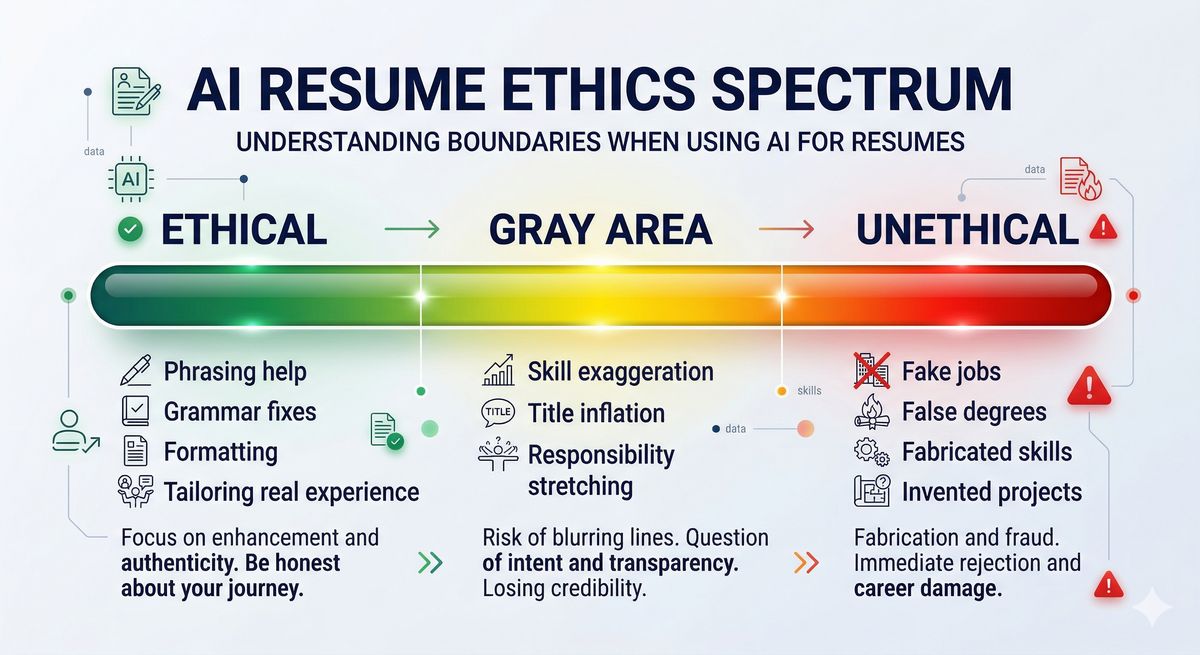
If AI helps you phrase your real experience more clearly, structure your achievements better, or save time on repetitive writing, that is ethical.
If AI invents experience, upgrades your skills beyond reality, fabricates metrics, or writes claims you never review, that is not ethical. That is misrepresentation.
So the real distinction is not "AI or no AI."
The real distinction is:
- AI as assistant: ethical
- AI as fabricator: unethical
Why This Question Matters
A resume is not a blog post. A cover letter is not creative fiction. A job application is a professional trust document.
When an employer reads your application, they are making several assumptions:
- You stand behind the claims in it
- You can explain the experience in an interview
- The accomplishments are real
- The skills listed are skills you can actually use
If those assumptions are false, the problem is not "you used AI." The problem is that you lied.
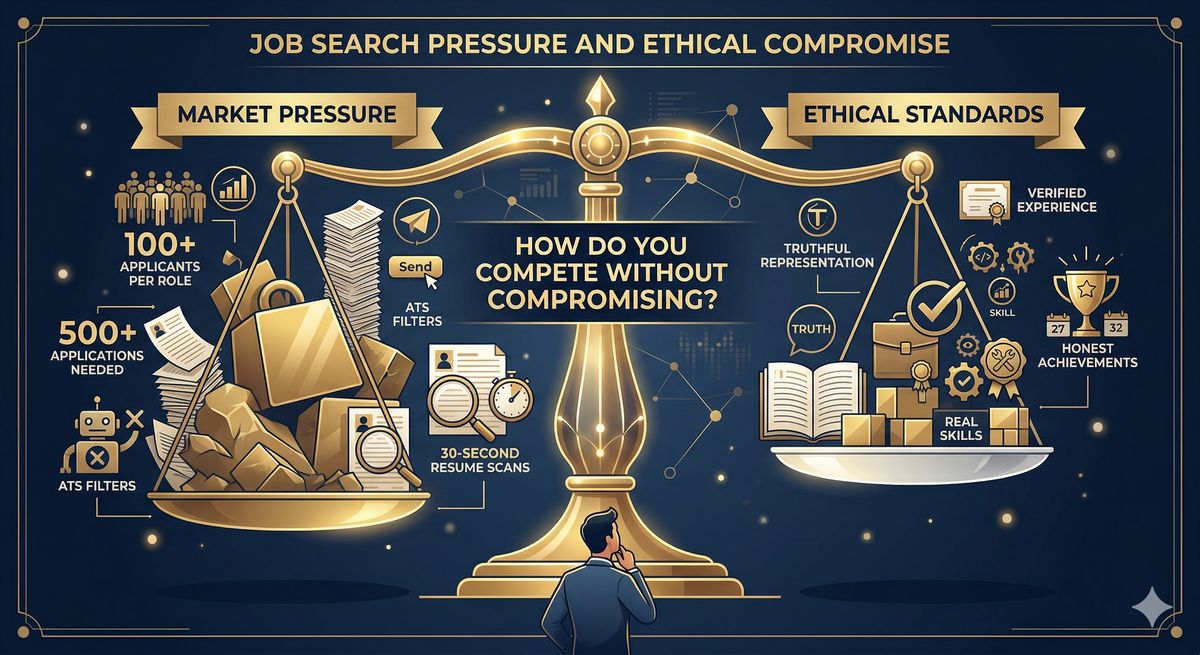
That matters because hiring decisions compound. A false claim can get you through screening, but it creates problems later:
- You cannot answer interview questions
- Your manager discovers gaps after hiring
- A background check exposes inconsistencies
- Your credibility takes a hit that is hard to recover from
The ethical risk is not automation. The ethical risk is fabrication.
What Is Ethical in AI Job Applications
There are many uses of AI in job search that are not just acceptable, but practical.
1. Improving the wording of your real experience
Many people are bad at writing about themselves. That does not make them unqualified. AI can help turn vague, passive bullets into stronger, clearer language without changing the underlying truth.
Weak:
- Responsible for customer onboarding
Stronger and still honest:
- Managed customer onboarding for mid-market clients, reducing ramp time by 30%
If the second line is true, AI did not create dishonesty. It created clarity.
2. Extracting relevant keywords from the job description
ATS systems score documents partly on keyword alignment. Using AI to identify which skills, tools, and phrases the employer is emphasizing is no different from being strategic.
3. Structuring achievements more clearly
Many candidates bury their best evidence. AI can help reorder bullets, elevate stronger accomplishments, and remove filler.
4. Writing professional emails
Application emails and follow-up emails are repetitive. There is nothing unethical about using AI to draft a polished version, as long as the message is accurate and you approve it.
5. Formatting documents for ATS compatibility
Using AI or an AI-powered tool to create a clean, ATS-safe resume is an efficiency gain, not an ethical breach.
6. Saving time on repetitive work
This point matters more than people admit. Job searching is labor. If AI removes repetitive formatting and rewriting work so you can focus on strategy, interviews, and networking, that is a legitimate use of a tool.
What Is Unethical
This is the part people try to blur. It is actually simple.
1. Inventing experience you do not have
If AI adds a responsibility, project, leadership scope, industry experience, or technical capability that never happened, the output is unethical.
2. Claiming skills you cannot demonstrate
Listing Python because AI saw it in the job description is unethical if you cannot actually use Python.
3. Fabricating metrics
"Increased revenue by 42%" sounds impressive. If you cannot support the number, it should not be there.
4. Misrepresenting your role in a project
Turning "supported the rollout" into "led the rollout" is not optimization. It is a lie.
5. Sending output without reviewing it
This is a huge one. Even if you did not ask AI to lie, sending unreviewed output means you are taking responsibility for claims you may not have checked.
6. Using AI to lie more efficiently
That is the bottom line. The ethical problem is not that AI can write well. The ethical problem is that it can help someone produce polished dishonesty faster.
The Ghostwriter Analogy
People often act like using AI means the words are no longer "yours." That standard does not hold up very well in real professional life.
CEOs use speechwriters. Executives use assistants to draft emails. Founders work with editors on investor letters. Professionals use spell-check, grammar tools, and templates constantly.
We do not call all of that cheating.
Why? Because the ethical standard is not "Did you type every word personally?"
The ethical standard is:
- Are the claims true?
- Did you approve the final message?
- Can you stand behind it?
AI is closer to a career coach, editor, or drafting assistant than a counterfeit machine, at least when used correctly.
If a coach helps you frame your story better, that is not unethical. If a coach tells you to invent a promotion you never earned, that is unethical. Same principle.
Where Employers Actually Draw the Line
Most employers are not sitting around asking whether you used AI to improve a bullet point.
What they care about is whether your application is credible.
Most reasonable employers are fine with AI-assisted writing if:
- The experience is real
- The claims are accurate
- The candidate can speak to them confidently
- The writing is not obviously disconnected from the candidate's communication ability
What employers are not fine with:
- Fabricated experience
- Skills inflation
- Resume language that collapses under basic interview questions
- Cover letters that sound polished but prove nothing
The interview is the truth test.
If your resume says you built a forecasting model, you should be able to explain the business problem, the tools you used, the quality of the data, the outcome, and your actual role in the work.
If you cannot, the issue is not that AI helped write the bullet. The issue is that the bullet was false or exaggerated.
There is also one more practical line: when the writing quality is wildly above the candidate's ability to communicate. That gap creates suspicion fast.
How Karko AI Enforces Ethical Use
This is where product design matters.
Some AI job tools optimize only for output quality. That is dangerous. If the system is rewarded for sounding impressive at all costs, it will drift toward embellishment.
Karko AI takes the opposite approach.
Its workflow is built around zero fabrication. The model is supposed to work from your real source material, not invent a better past for you.
That shows up in a few ways:
- It uses your uploaded CV or master CV as source context
- It focuses on selecting and reframing documented experience
- It surfaces fit gaps instead of hiding them
- It is designed to avoid hallucinated claims
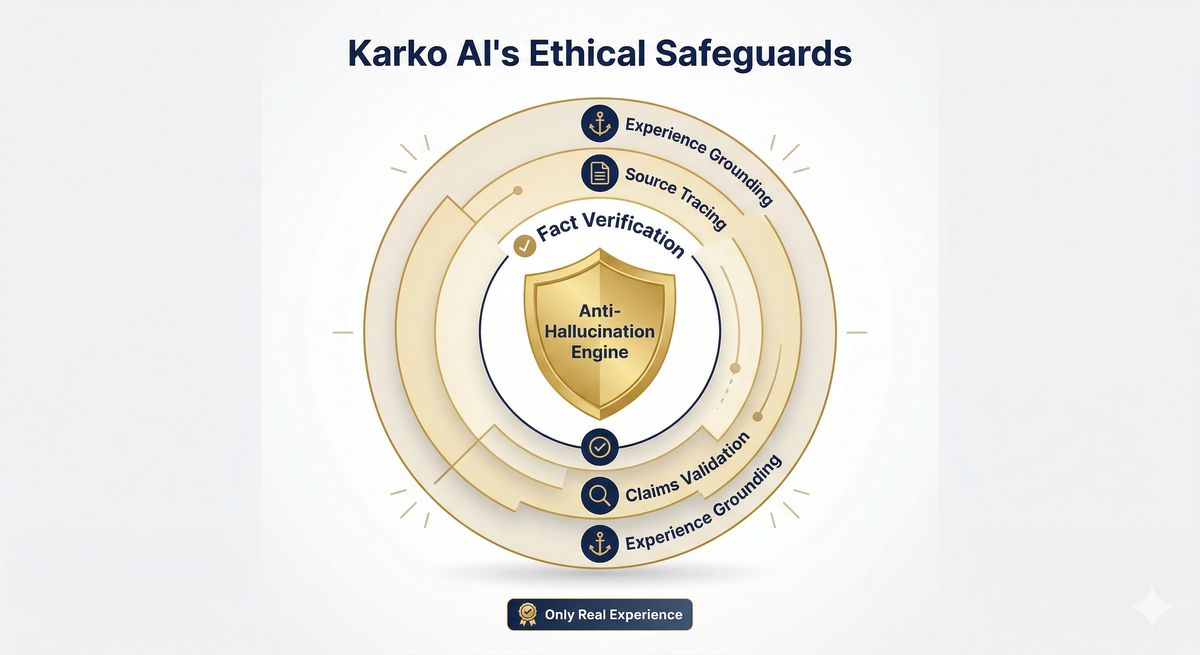
If you want the full principle, the best reference point in the product is Karko's zero-fabrication approach.
That is the ethical line translated into product behavior: better articulation of reality, not synthetic credibility.
Best Practices for Using AI Ethically in Your Applications
If you want a simple operating system, use this checklist.
Rule 1: Start from a complete, honest source document
The better your source CV, the less likely AI is to fill gaps badly.
This is why thin, outdated resumes create ethical risk. When the source document is incomplete, candidates are more tempted to let the tool "fill in the blanks." That is exactly the moment where honest assistance turns into embellishment.
Rule 2: Review every claim
Do not skim. Read line by line and ask: Did I actually do this? Can I explain this? Can I prove this?
That review should include your resume, cover letter, and email. Candidates often focus only on the resume and forget that cover letters are full of implied claims about motivation, domain fit, and project relevance.
Rule 3: Check numbers carefully
Metrics are where overstatement happens fastest.
Rule 4: Remove anything you cannot defend in an interview
If you are nervous about being asked about a line, that is a warning sign.
Rule 5: Use AI to clarify, not inflate
Sharper wording is good. Bigger claims are not automatically better.
Rule 6: Let the fit score save you from bad applications
An honest AI workflow should tell you where the gaps are. That is useful. Not every role is a match.
There is also a broader principle here: using AI ethically means staying accountable for the final document. The tool can draft. The tool can reorganize. The tool can suggest. But you are still the person attaching your name to the application.
That means authorship, in an ethical sense, is not about typing every sentence yourself. It is about ownership. If the final application represents your real background and you knowingly approve it, the process is still yours. If you do not know what is in it, or you would struggle to defend it live, you have outsourced too much.
The Honest Verdict
Using AI for job applications is not inherently unethical.
Using AI to misrepresent yourself is.
That is the difference.
If AI helps you organize your experience, tailor your resume, write a clearer cover letter, and save time on repetitive work, you are using a tool responsibly.
If it helps you claim work you never did, you are not being efficient. You are being dishonest.
The same rule has always applied in hiring: tell the truth, present it well, and stand behind what you send.
AI does not change that. It just makes the consequences of using the tool well or badly show up faster.
Try It Yourself
Karko AI helps you write stronger applications without crossing the line. It is built to work from your real experience, not fictional upgrades of your background.
That means you can move faster, improve your presentation, and still know the document represents what you can actually defend.
Try Ethical AI Job Applications Free — 2 Applications, No Credit Card
Wasim Jalali is the founder of Karko AI. He built it because he believed AI should reduce job search friction without turning honest applicants into fiction writers.
Use AI Without Crossing the Line
Karko AI helps you phrase real experience better without inventing skills, achievements, or history.
Try Ethical AI Job Applications FreeRelated articles.
Your entire job search, in one app
Job seekers run seven tools to send one application. Here is why that stack is quietly breaking your results, and what one app for the whole loop actually looks like.
Best AI Job Application Tools 2026: Features & Pricing
Compare the top AI job application tools in 2026. From resume builders to full applications, find the right tool for your job search strategy.