How Long Does It Take to Apply for a Job in 2026?
The average application takes 45–60 minutes. Multiply by 100 and you get 75 hours of unpaid work. Here's how AI cuts that to 2.5 hours.

You already know the job market is brutal right now. What you probably haven't done is the actual math on how much time you're burning through just to apply.
I did. And the numbers made me build a product.
The Real Cost of a Single Tailored Job Application
Let's break down what a properly tailored job application actually looks like. Not a mass-apply, not a copy-paste-and-pray approach. A real, competitive application that gives you a fighting chance.
Here's what it takes:
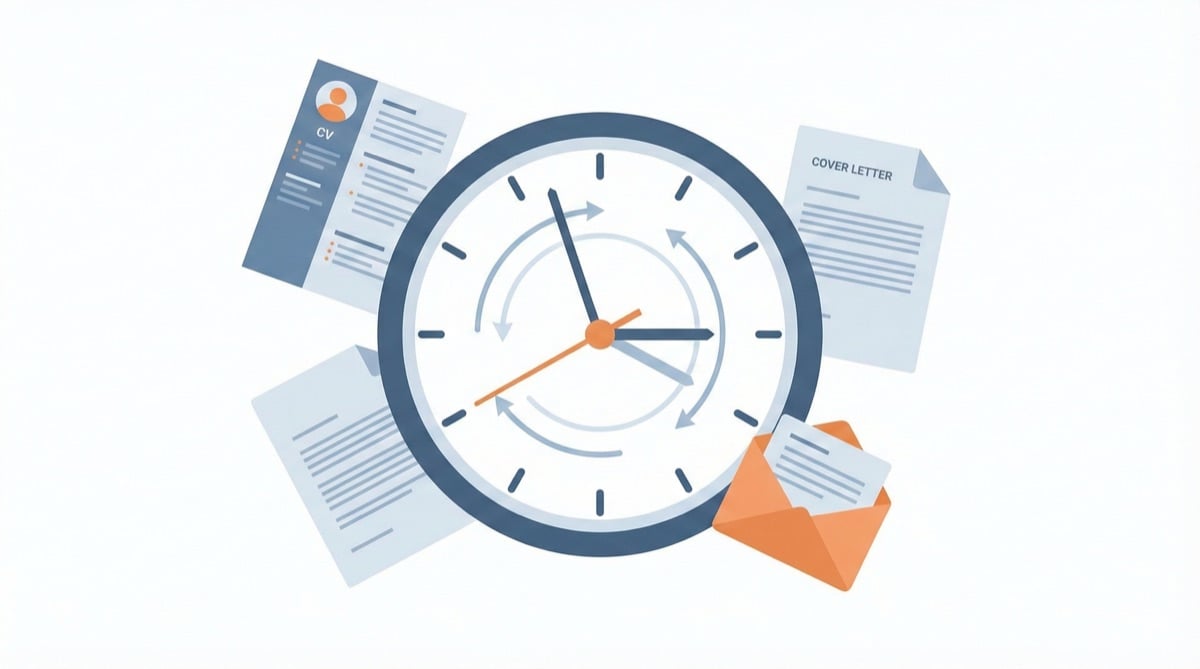
Researching the company to write something specific in your cover letter, not a generic "I am excited to apply for this role at [Company]." That's 10 to 15 minutes if you're fast.
Tailoring your CV to match the job description. Reordering your skills, adding relevant keywords so the ATS doesn't reject you before a human ever sees your name, removing irrelevant experience. That alone takes 15 to 25 minutes, sometimes longer if you're redesigning sections.
Writing a personalized cover letter that actually references the company, the role, and why your specific experience matters. Another 10 to 15 minutes, assuming you're a decent writer and don't stare at a blank page for 20 minutes first.
Drafting the application email with a professional subject line, a concise body, and the right attachments. 5 minutes if you've done it before.
Total: 45 to 60 minutes per application. On the conservative side.
That lines up with what career experts recommend. Most sources suggest spending 30 to 60 minutes per tailored application, and some say up to 90 minutes for roles you really want.
Now Multiply That by 100
Here's where the math gets ugly.
Recent data from multiple hiring studies paints a clear picture: in 2026, the average job seeker needs to submit anywhere from 32 to 200 or more applications to land a single job offer. Some studies put the number even higher, with estimates reaching 400 or more applications in competitive fields.
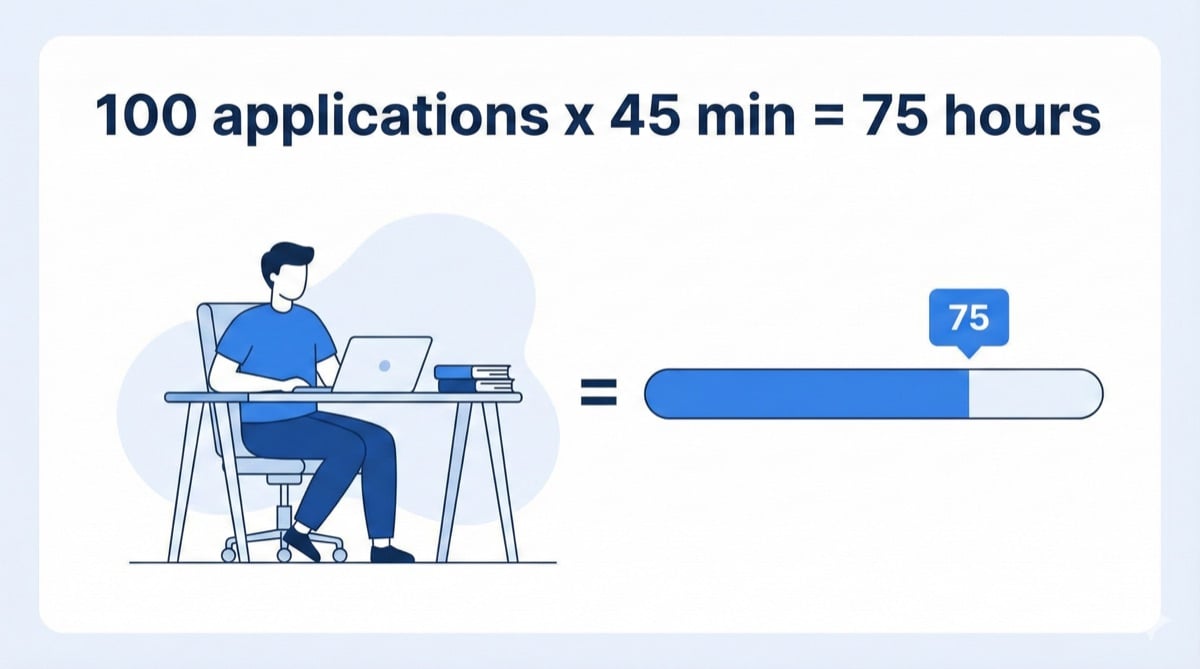
Let's use a modest number: 100 applications.
At 45 minutes per tailored application, that's 75 hours of work. That's almost two full work weeks of unpaid labor, just to fill out applications.
And that's assuming you're efficient. Most people aren't. Most people spend extra time second-guessing their word choices, reformatting their CV for the third time, and writing cover letters that still open with "I am writing to express my interest" because they've run out of creative energy by application number 12.
Meanwhile, the hiring timeline keeps stretching. The median time to a first job offer in 2025 went from 57 days in Q1 to 83 days by Q4. Companies are conducting 42% more interviews per hire than they were in 2021. The process is getting longer and harder on both sides.
But here's the part that actually matters: tailored applications work. Research from Huntr's 2025 Annual Job Search Trends Report, based on 1.7 million applications and 243,000 resumes, shows that tailored resumes convert to interviews at a 5.8% rate, which is 1.6 times higher than untailored ones.
The data is clear. Tailoring works. The problem isn't the strategy. The problem is the time it takes to execute it.
The Two Bad Options Most Job Seekers Choose
Most job seekers fall into one of two camps, and both are losing strategies.
Camp 1: Mass apply with a generic CV. You send the same resume to 200 jobs, hoping something sticks. It's fast, maybe 5 minutes per application. But your callback rate hovers around 2% or lower. You're playing a lottery, not running a job search. Worse, 76% of generic resumes get filtered out by ATS software before a recruiter ever sees them. And 43% of recruiters say they immediately reject obviously generic applications.
Camp 2: Hand-tailor every application. You spend an hour per application, writing beautiful cover letters and perfectly optimized CVs. The quality is high, but you can only do 5 to 7 applications per day at most. At that pace, getting through 100 applications takes 3 or more weeks of full-time effort. If you're also working, caring for family, or just trying to stay sane, the math doesn't work.
Neither camp wins. Camp 1 wastes applications. Camp 2 wastes time. Both lead to the same place: burnout, frustration, and the creeping feeling that the system is broken.
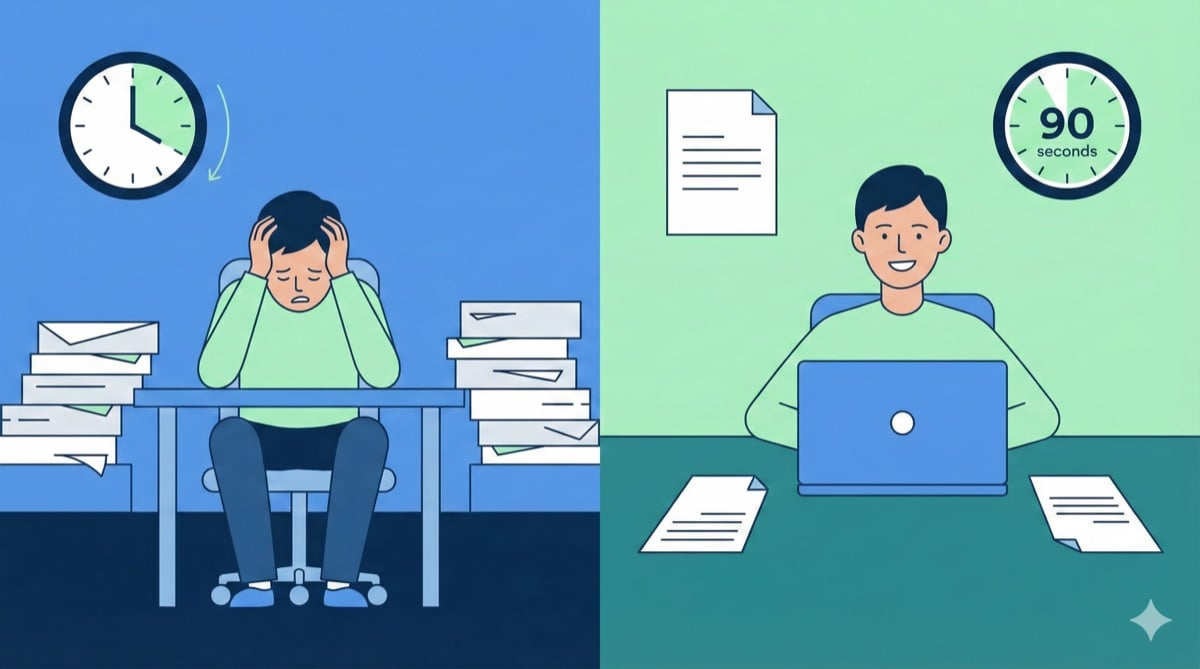
What If You Could Tailor Every Application in 90 Seconds?
This is the question I asked myself when I was sitting in my apartment in Germany with 50 euros in my bank account, my startup running on fumes, and no interviews from dozens of generic applications.
I knew from the data that tailored applications performed dramatically better. But I physically couldn't spend an hour on each one. I didn't have the time or the money to burn through weeks of manual applications.
So I built a solution.
First, I built a manual prototype: a Claude AI project loaded with my CV as context, where I would paste each job description and manually generate tailored outputs. The quality was good. I started getting results. Within about 20 applications, I had my first interview.
But even that manual process took 45 to 60 minutes per application. It wasn't scalable.
So I built Karko AI. An AI agent that takes your CV and a job description, analyzes the fit, and generates a full application, optimized CV, personalized cover letter, and professional email, in under 90 seconds.
The Math, Completely Rewritten
Let's redo the calculation with Karko AI.
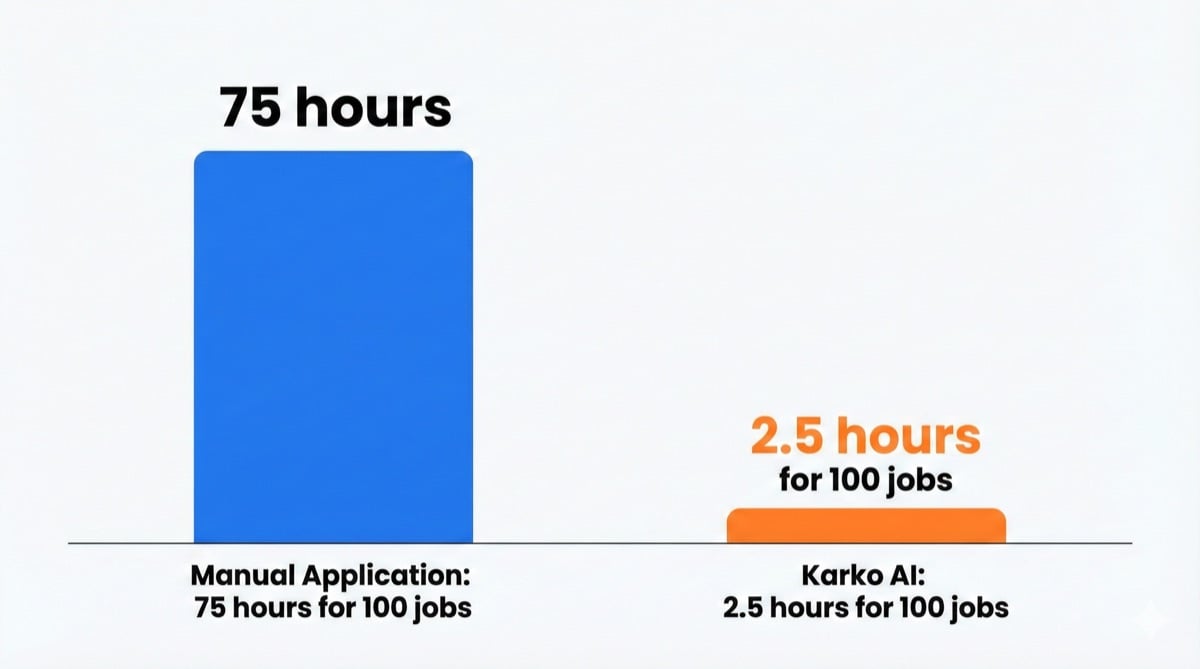
100 applications at 90 seconds each: 2.5 hours total.
That's 75 hours compressed into 2.5 hours. Roughly 40x faster per application.
But the quality doesn't drop. Every CV is tailored with ATS-optimized keywords pulled from the specific job description. Every cover letter opens with an achievement, not a cliche, and references the specific company. Every email is professionally formatted with the right subject line and attachment references.
And critically, every application includes an honest fit assessment that tells you upfront how well your profile matches the role. No false hope, no fabricated skills. If you're a 60% match, Karko tells you that, along with exactly which gaps exist, so you can decide whether to apply or move on.
Here's what that actually looks like in practice. Instead of spending an entire weekend on 10 applications, you can apply to 100 jobs in a few days. Instead of 75 hours a month on applications alone, you save 40 to 50 or more hours every month. Hours you can spend networking, preparing for interviews, learning new skills, or just not losing your mind to job search burnout.
The Difference Isn't Speed. It's Volume With Quality.
The real advantage isn't just that Karko AI is fast. It's that speed plus quality changes the entire math of your job search.
When tailoring takes an hour, you have to be selective. You can only afford to apply to a handful of jobs per day. You skip roles that seem like a stretch. You don't apply to the backup options. You narrow your search because you have to.
When tailoring takes 90 seconds, you can apply to every relevant role. The stretch roles, the dream jobs, the ones in a different city, the ones that seem like a long shot. You can afford to cast a wider net without sacrificing quality, which is exactly what the data says you should be doing.
The job seekers who find work fastest aren't necessarily the most qualified. They're the ones who get their tailored application in front of more hiring managers, faster.
Try It Yourself
Karko AI is free for your first 2 applications. No credit card. No sign-up wall for the free tier. Just paste a job description and see what comes back.
If you're currently in a job search, you already know how much time you're spending. The question is whether you want to keep spending it the same way.
Try Karko AI Free — 2 Applications, No Credit Card
Wasim Jalali is the founder of Karko AI. He built it because he was broke, job hunting, and tired of spending hours on applications that went nowhere. Now he's making sure nobody else has to.
Ready to apply smarter?
Generate a complete job application (optimized CV + cover letter + email) in under 90 seconds.
Try Karko AI Free - 2 Applications, No Credit CardRelated articles.
A smart job feed that reads your CV, not just keywords
The average job search takes 5 months. Here is how an AI-curated daily feed cuts the browsing out so you spend your time applying, not scrolling.
The screening question wall, and how to stop hitting it
Screening questions are where strong applications go to die. Here is how to answer them in minutes with specificity, not generic paragraphs written under fatigue.