Follow-Up Email After Job Application: When & What to Say
Most candidates never follow up. The ones who do stand out. Learn when to send a follow-up email, what to write, and how AI can draft a professional one in seconds.

You submitted your application three weeks ago. You've refreshed your inbox 47 times. You've checked your spam folder twice. Still nothing.
So you're stuck with the question every job seeker asks: Should I follow up?
The short answer: Yes. The data says yes. The hiring managers say yes. But most people either wait too long, send the wrong message, or skip it entirely because they don't know what to write.
This guide covers exactly when to send a follow-up email, what to include, and how to do it in a way that increases your chances without being annoying.
Why Follow-Up Emails Actually Work
Most candidates never follow up. That alone puts the ones who do ahead of the pile. No magic, just patience and a polite nudge at the right time.
Here's why it works:
Your application got lost. Not metaphorically. Literally. Recruiters receive 250+ applications per open role on average. Even if your CV is perfect, it might have been skimmed in 6 seconds during a Monday morning inbox triage. A follow-up brings you back to the top of the pile.
It signals genuine interest. Most candidates mass-apply and move on. A thoughtful follow-up tells the hiring manager you actually care about this specific role. That matters more than you think.
Timing is everything. If you follow up at the right moment (we'll cover when below), you catch the recruiter at the exact stage where they're reviewing shortlisted candidates or scheduling interviews. Perfect timing can turn a "maybe" into a "yes."
When to Send a Follow-Up Email
Timing is the difference between helpful persistence and being annoying.
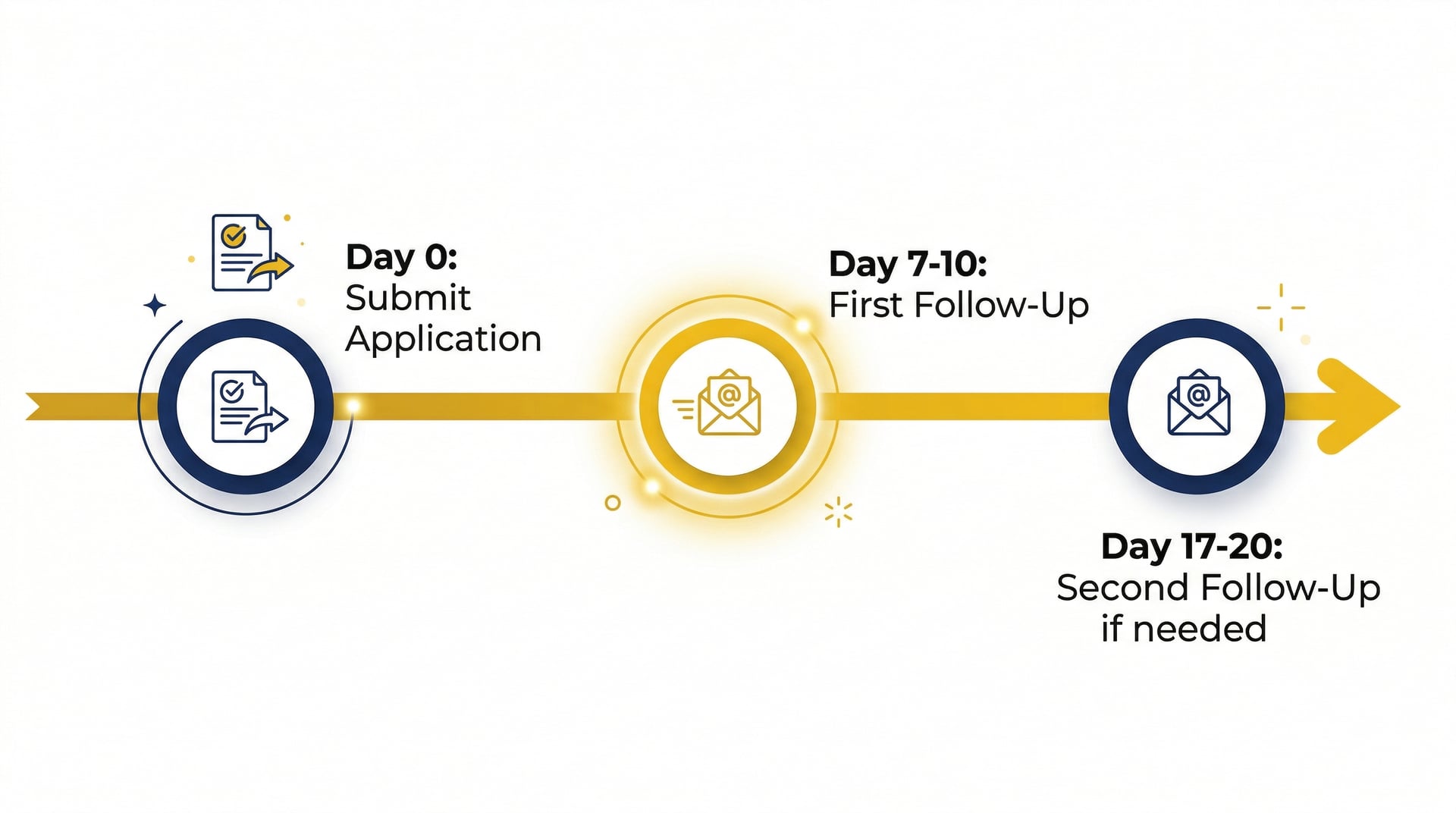
Standard timeline: 7 to 10 business days after submitting your application.
Why? Most companies aim to respond within 1 to 2 weeks. If you follow up on day 3, you're jumping the gun. If you wait 4 weeks, the role might already be filled.
Exception 1: If the job posting mentions a timeline ("We will respond within 3 weeks"), wait until that deadline passes, then add 2 to 3 business days.
Exception 2: If you applied through a personal referral or internal recruiter, you can follow up sooner, around 5 to 7 days, because there's already a connection.
Exception 3: If it's a high-urgency role (contract, seasonal, or "immediate start"), you can follow up after 5 days.
One follow-up is professional. Two follow-ups (spaced 7 to 10 days apart) is acceptable if you got no response. Three follow-ups is pushing it. More than three and you're burning bridges.
What to Include in Your Follow-Up Email
A good follow-up email does three things:
- Reminds them who you are (without making them search their inbox).
- Reiterates your interest and fit (briefly, not a repeat of your cover letter).
- Makes it easy for them to respond (one clear question or next step).
Here's the structure:
Subject line: Reference the role and your application date. Examples:
- "Following up: [Job Title] application submitted [Date]"
- "Re: [Job Title] — Application from [Your Name]"
Opening: Polite, direct, no fluff. State the role, when you applied, and that you're following up.
Middle: One to two sentences reinforcing your fit. Pick one key skill or achievement that aligns with the role. Do not rehash your entire CV.
Closing: Ask a specific question or offer to provide more information. Then thank them for their time.
Length: 100 to 150 words. Anything longer and you've lost them.
Example Follow-Up Email (Manual Version)
Subject: Following up: Senior Data Analyst application submitted March 15

Hi [Hiring Manager's Name],

I applied for the Senior Data Analyst position on March 15 and wanted to follow up to confirm that my application was received. I'm very interested in this role and believe my experience building predictive models for SaaS products aligns well with the requirements outlined in the job description.

If there's any additional information I can provide to support my application, I'm happy to share it. I'd also welcome the opportunity to discuss how my background in Python and SQL optimization could contribute to [Company Name]'s data team.

Thank you for your time, and I look forward to hearing from you.

Best regards,
[Your Name]
[LinkedIn Profile or Portfolio Link]
Notice what this does:
- Reminds them: Role + date.
- Reinforces fit: One specific skill match.
- Opens the door: Offers to provide more info or discuss further.
- Stays short: 120 words.
What NOT to Include
Don't apologize for following up. "Sorry to bother you" signals that you think you're an inconvenience. You're not. Following up is normal.
Don't sound desperate. "I really, really need this job" or "I've been applying everywhere" undermines your position. Stay professional.
Don't complain about the timeline. "I haven't heard back in 3 weeks and that's too long" is a fast way to get ignored. Companies move slowly. That's the reality.
Don't attach new documents unless they specifically requested them. Your CV and cover letter are already in their system. Resending them looks like you didn't trust them to keep the first version.
Don't write a novel. If your follow-up is longer than your original cover letter, you've lost the plot. Keep it tight.
How AI Can Generate the Perfect Follow-Up Email
Writing a follow-up email manually takes 10 to 15 minutes if you're trying to get the tone right. Most people procrastinate because they don't know how to phrase it without sounding pushy.
Karko AI generates a professional follow-up email in under 90 seconds. It's part of the 4-document package: CV, cover letter, application email, and follow-up email. All tailored to the same job description, all consistent in tone and claims.
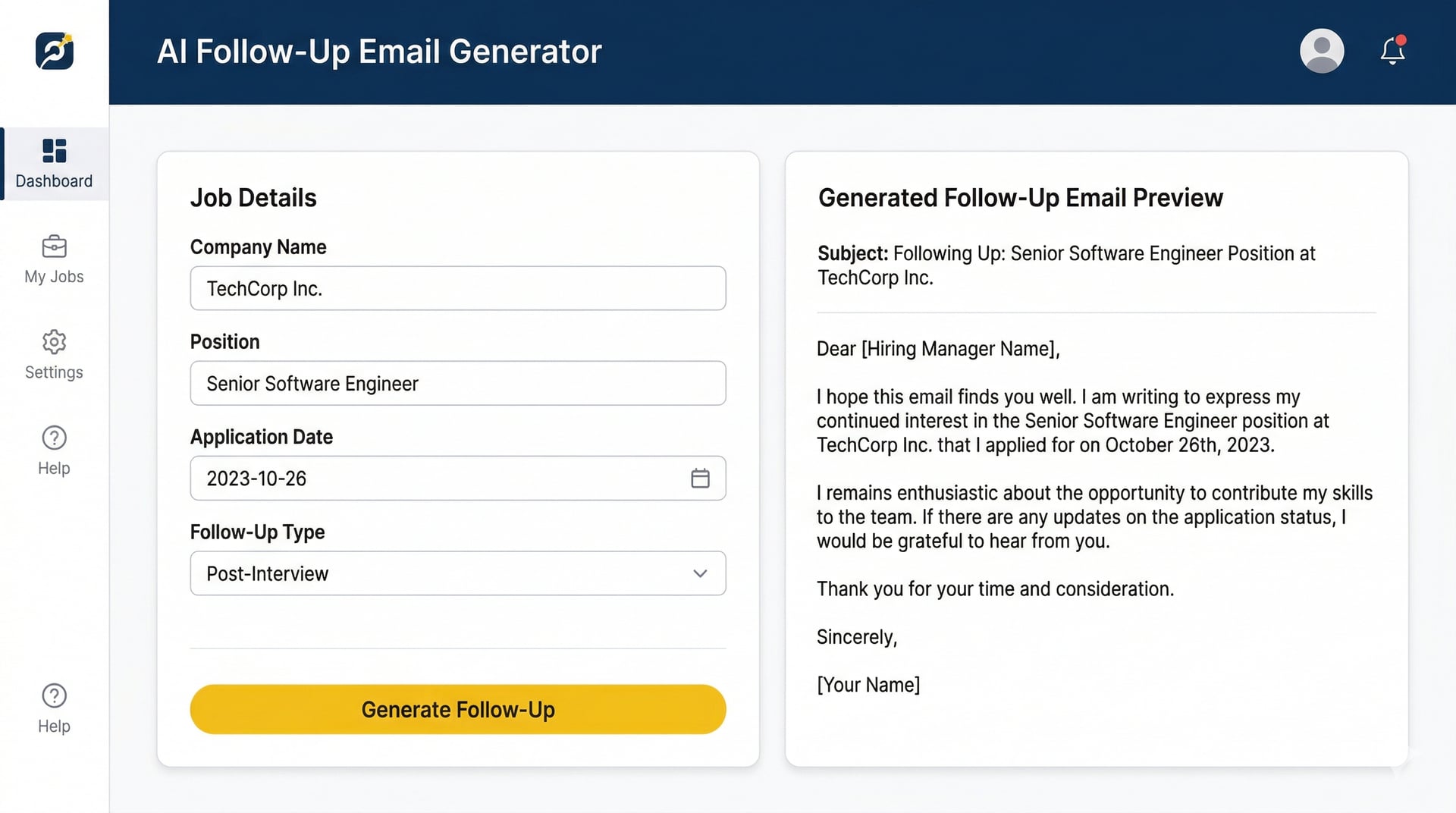
The follow-up email Karko generates includes:
- The role and application date (pulled from your input).
- A brief reiteration of your top relevant skill or achievement (pulled from your real CV).
- A polite request for an update or next steps.
- Professional tone with no filler.
You get the follow-up email when you first generate your full application. So when day 7 to 10 rolls around, you already have it ready to send. No staring at a blank screen. No overthinking the phrasing. Just open, review, and send.
The Edge
The job market in 2026 is brutal. You're competing with hundreds of other qualified candidates. Most of them submit an application and never follow up.
The ones who do stand out. No magic. Just a polite nudge at the right time, when the recruiter is actually reviewing shortlisted candidates.
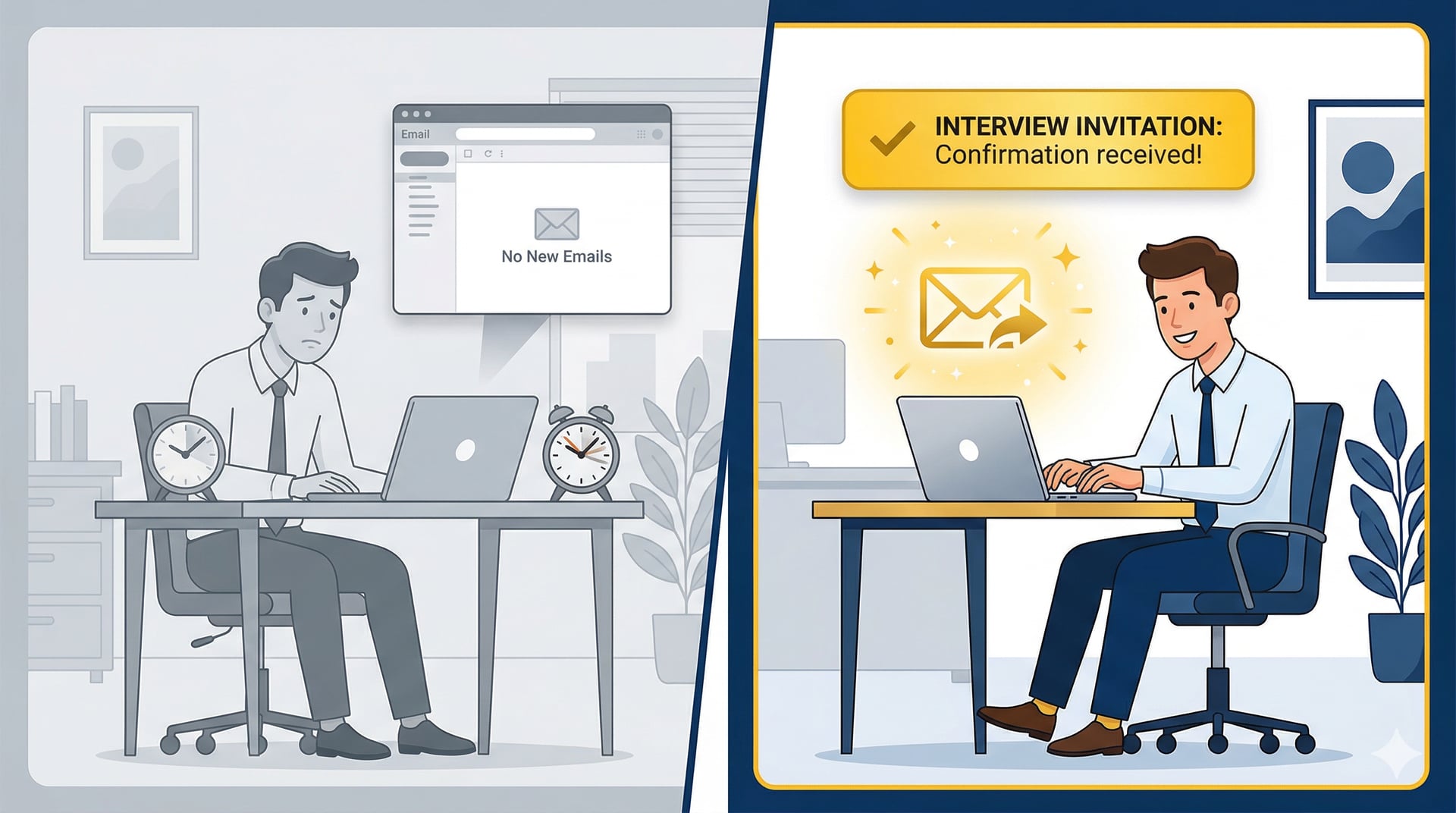
The candidates who get hired aren't always the most qualified. They're the ones who stayed visible, followed up at the right time, and made it easy for hiring managers to say yes.
Try It Yourself
Karko AI is free for your first 2 applications. That includes the follow-up email. No credit card. No sign-up wall.
If you're in a job search right now, you already know how much time you're spending per application. The question is whether you want to keep doing it manually, or let AI handle the heavy lifting while you focus on preparing for interviews.
Generate Your Follow-Up Email Free — 2 Applications, No Credit Card
Wasim Jalali is the founder of Karko AI. He built it because he was broke, job hunting, and tired of spending hours on applications that went nowhere. Now he's making sure nobody else has to.
Generate Your Follow-Up Email in 90 Seconds
Get a professional follow-up email as part of your full application. Free for 2 applications.
Generate Follow-Up Email Free