AI Cover Letter Generator: How It Works
A cover letter that reads as written for this role beats a generic template every time. Learn how AI generates a tailored cover letter in seconds without fabricating experience.

Generic cover letter templates don't work.
You know the type. "Dear Hiring Manager, I am writing to express my interest in the [Job Title] position at [Company Name]."
Recruiters see that opening line 200 times per role. It signals exactly one thing: you didn't put in any effort.
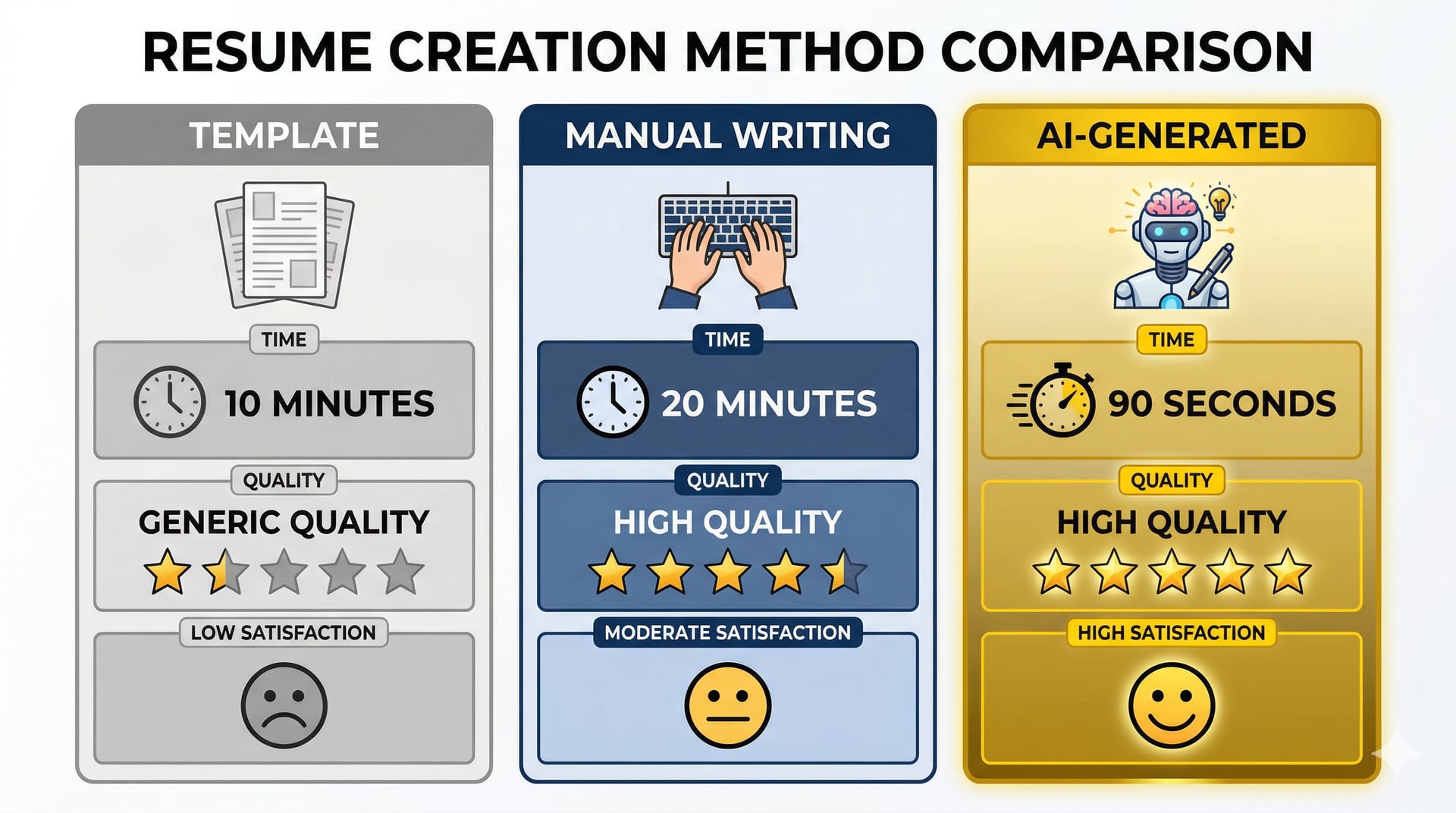
A cover letter that reads as written for this role beats a generic template every time. The specifics do the lifting: your real achievements, the role's real requirements, the company's real context. But writing a tailored cover letter manually takes 15 to 20 minutes per job. If you're applying to 100 jobs, that's 33 hours of writing.
AI changes the math. An AI cover letter generator writes a tailored, role-specific cover letter in under 90 seconds. Same quality as a hand-written letter, roughly 40x faster.
This guide explains how AI cover letter generators work, what separates a good one from a bad one, and why AI-generated cover letters outperform templates when done right.
How AI Cover Letter Generators Work
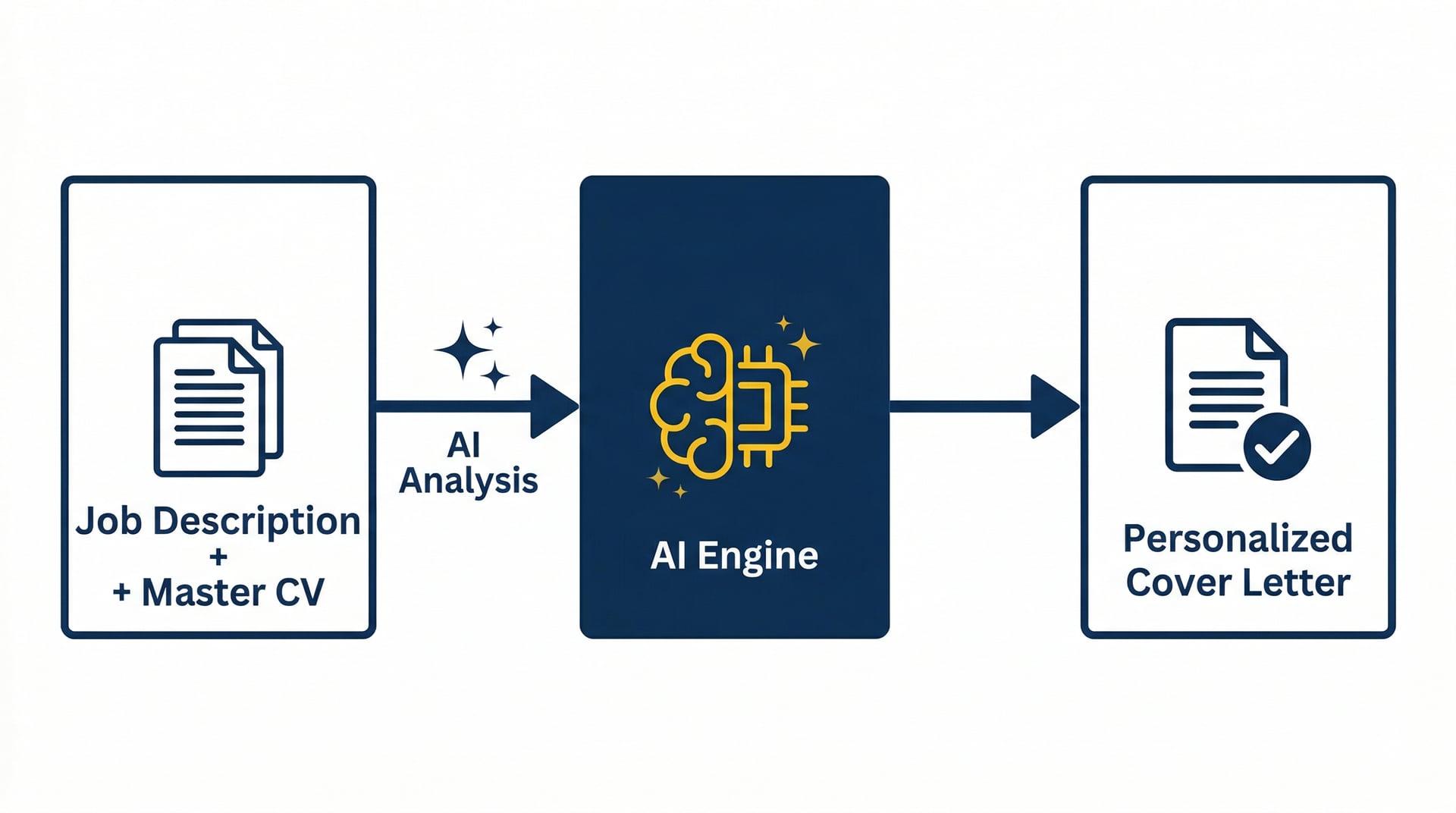
At a high level, an AI cover letter generator does three things:
- Analyzes the job description to extract key requirements, company context, and role responsibilities.
- Maps your experience to those requirements by pulling relevant achievements from your CV.
- Writes a personalized cover letter that explains why you're a strong fit, using natural language and a professional tone.
The quality depends on two factors: data accuracy and structural safeguards against fabrication.
The Data Input: Job Description + Your CV
The AI needs two inputs:
Input 1: The job description. This tells the AI what the employer is looking for: required skills, role responsibilities, company values, and any specific projects or challenges mentioned in the posting.
Input 2: Your real CV. This is the source of truth for your real experience, skills, and achievements. Everything the AI writes must trace back to this document. The more detail on your CV, the more the AI has to work with.
The critical rule: The AI should never invent experience you don't have. If your CV says you have Python experience, the cover letter can mention Python. If your CV doesn't, the cover letter shouldn't either.
The Analysis: Extracting What Matters
The AI reads the job description and identifies:
- Top 5 to 7 required skills (e.g., "Python," "project management," "stakeholder communication").
- Key responsibilities (e.g., "lead cross-functional teams," "build scalable systems").
- Company context (e.g., "fast-growing SaaS startup," "enterprise healthcare provider").
Then it scans your CV for relevant experience that matches those requirements. If the job emphasizes leadership and you've led a team, that becomes a focal point. If the job emphasizes technical skills and you've built systems, that becomes the focus.
The Writing: Structure and Tone
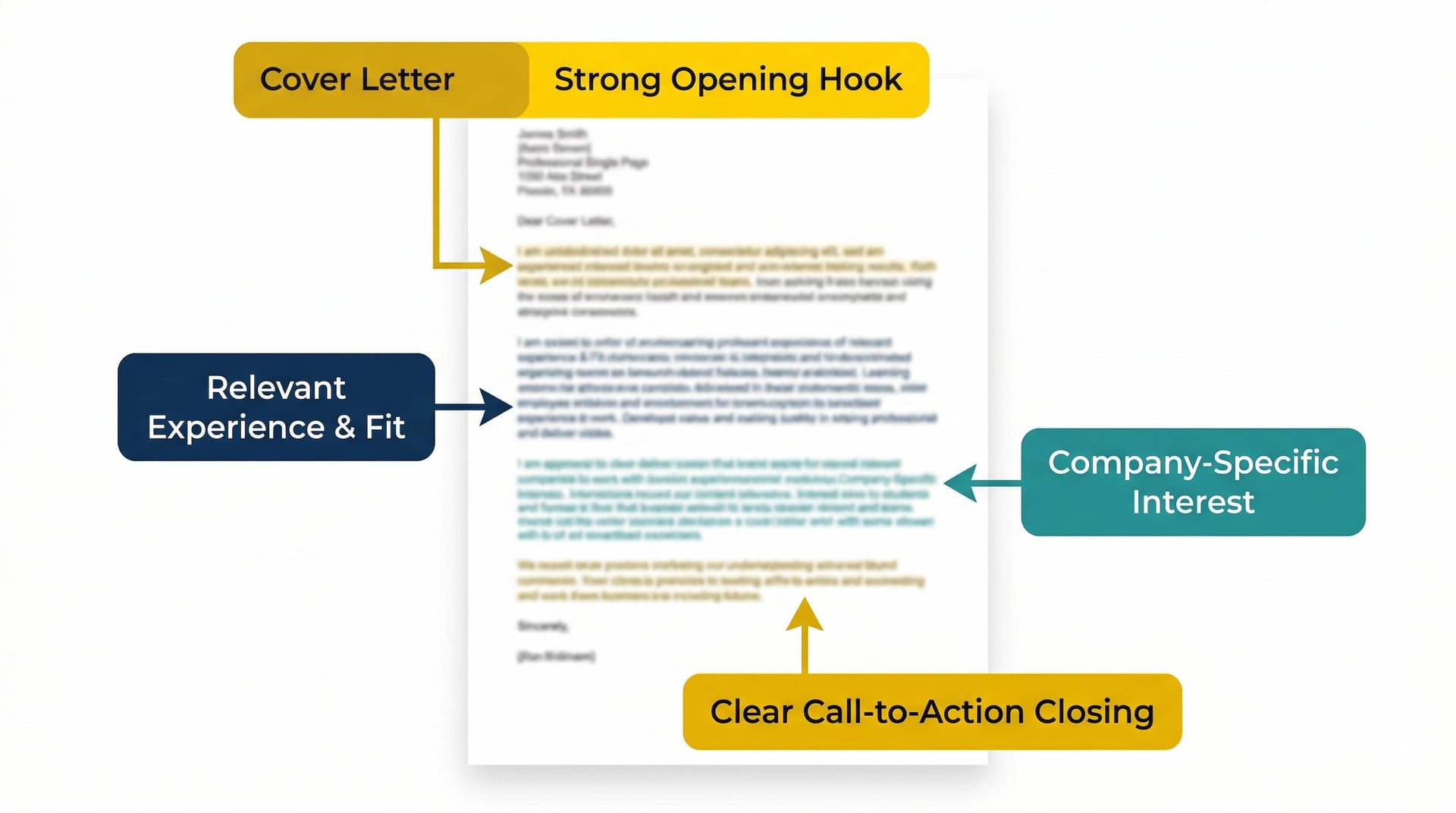
A well-designed AI cover letter generator follows this structure:
Paragraph 1: Strong opening. Instead of "I am writing to express my interest," open with a specific achievement or reason you're interested in this role.
Example:
"After building scalable data pipelines that processed 10M+ events per day at [Previous Company], I'm excited to bring that expertise to [Target Company]'s data engineering team."
Paragraph 2: Fit and relevance. Explain how your experience aligns with the role's top 2 to 3 requirements. Use specific examples from your CV.
Example:
"Your job posting emphasizes Python and SQL optimization. In my previous role, I reduced query execution time by 40% through indexing and query refactoring, directly impacting the performance of customer-facing dashboards."
Paragraph 3: Company-specific interest. Reference something specific about the company (mission, product, recent news) that shows you've done research.
Example:
"I'm particularly drawn to [Company]'s focus on healthcare interoperability. Having worked on FHIR integration projects, I understand the technical and regulatory challenges of this space."
Paragraph 4: Closing. Brief, confident, and forward-looking.
Example:
"I'd welcome the opportunity to discuss how my background in data engineering can contribute to [Company]'s goals. Thank you for your consideration."
Length: 250 to 350 words. Short enough to read in 90 seconds. Long enough to demonstrate genuine interest.
What Separates a Good AI Cover Letter from a Bad One
Not all AI cover letter generators are the same. Here's what matters:
1. Anti-Hallucination Safeguards
The problem: Many AI tools fabricate experience. They see a job requirement for "AWS" and write "I have extensive AWS experience" even if your CV never mentions AWS.
The fix: A good AI cover letter generator enforces strict traceability. Every claim must map back to your uploaded CV. If you don't have AWS experience, the cover letter won't mention it.
Karko AI uses a structural anti-hallucination system. The AI agent is explicitly forbidden from inventing skills, metrics, or roles. If it tries to fabricate, the output is rejected and regenerated.
2. Personalization (Not Just Mail Merge)
The problem: Many "AI" tools are glorified templates with [Company Name] and [Job Title] placeholders swapped out. The content is generic.
The fix: True AI personalization means the tool reads the job description, identifies what matters most, and writes a cover letter that emphasizes your relevant experience for that specific role.
Example of mail merge (bad):
"I am excited to apply for the [Job Title] position at [Company Name]. I have experience in [Skill 1], [Skill 2], and [Skill 3]."
Example of AI personalization (good):
"Your emphasis on cross-functional collaboration aligns with my experience leading a 12-person team across engineering, design, and product to ship a new feature that increased user engagement by 25%."
The difference is specificity. A good AI tool doesn't just plug in keywords. It writes coherent, contextually relevant paragraphs.
3. Natural Tone (Not Robotic)
The problem: Early AI writing tools sounded like robots. Overly formal, awkward phrasing, repetitive sentence structure.
The fix: Modern AI (Claude, GPT-4) generates natural, professional tone that reads like a human wrote it. But the quality depends on the prompt engineering behind the tool.
A good AI cover letter generator produces text that:
- Sounds confident, not desperate.
- Avoids clichés ("I am a team player," "I thrive in fast-paced environments").
- Uses active voice and varied sentence structure.
4. Speed (Seconds, Not Minutes)
The problem: Some AI tools require multiple steps: upload CV, fill out a form, answer questions, wait for processing, edit the output.
The fix: A well-designed AI cover letter generator should take one input (job description) and produce a complete cover letter in under 90 seconds. No multi-step wizards. No manual editing required (though optional editing is always a good idea before sending).
Karko AI generates a cover letter as part of a 4-document package (CV, cover letter, application email, follow-up email) in one workflow. Total time: 90 seconds.
Why AI Cover Letters Beat Templates
Templates fail because they're generic. Every job seeker uses the same template. Hiring managers recognize them instantly.
AI cover letters win because they're specific. They reference the exact job requirements, your exact achievements, and the exact company context. They read like you spent 20 minutes writing them, even though it took 90 seconds.
The mechanism is simple: recruiters can tell within two sentences whether a cover letter was written for this job or sent to everyone. A tailored one earns the read. A generic one gets skimmed and moved past.
But "customized" doesn't mean "handwritten." It means tailored to the specific role and company. AI does that faster and more consistently than a human can.
Real Example: AI-Generated Cover Letter
Job: Senior Data Analyst at a SaaS company
Key requirements: SQL, Python, stakeholder communication, dashboard building
Applicant CV: 5 years of data analysis experience, SQL and Python skills, built dashboards, worked with cross-functional teams
AI-generated cover letter (excerpt):
"After building data dashboards in Tableau and SQL that informed product strategy for a 200-person SaaS company, I'm excited to bring that expertise to [Company]'s analytics team. Your job description emphasizes stakeholder communication and dashboard development, both of which have been central to my work. In my previous role, I collaborated with product and engineering teams to design dashboards that reduced time-to-insight by 40%, enabling faster decision-making for leadership.
I'm particularly drawn to [Company]'s focus on data-driven product development. The opportunity to work at the intersection of analytics and product strategy aligns closely with my experience and career goals."
Why it works:
- Opens with a specific achievement (built dashboards, 200-person company).
- References exact job requirements (stakeholder communication, dashboard development).
- Quantifies impact (40% reduction in time-to-insight).
- Shows company-specific interest (data-driven product development).
- Sounds natural, not robotic.
Time to generate: 90 seconds.
The Real Edge
A cover letter that reads as written for this role beats one that could have been sent anywhere. No stat needed. Any recruiter who opens both will tell you which one gets the read.
The job seekers who get hired fastest aren't necessarily the best writers. They're the ones who consistently send tailored, relevant applications to more employers, faster.
Writing 100 cover letters manually takes 33 hours. With AI, it takes 2.5 hours. Roughly 40x faster.
Try It Yourself
Karko AI is free for your first 2 applications. That includes the cover letter, plus the tailored CV, application email, and follow-up email. All four documents reference the same job description and draw from your uploaded CV.
No credit card. No sign-up wall. Paste a job description and see what comes back.
Generate an AI Cover Letter in 90 Seconds — 2 Applications Free, No Credit Card
Wasim Jalali is the founder of Karko AI. He built it because he was broke, job hunting, and tired of spending hours writing cover letters that went nowhere. Now he's making sure nobody else has to.
Generate Personalized Cover Letter in 90 Seconds
AI-written cover letters with company research. Free for 2 applications.
Generate Cover Letter Free